Here are some pickup lines I’ve collected over the years. Contributors are omitted — for their protection.
Geek Pick-up Lines, Part 1 11. Tell me of this thing you humans call *dramatic pause* love. 10. If you turn me down now, I will become more drunk than you can possibly imagine. 9. They don’t call me Bones because I’m a doctor. 8. Your name is Leslie? Look, I can spell your name on my calculator! 7. What’s a nice girl like you doing in a wretched hive of scum and villainy like this? 6. You must be Windows 95 because you got me so unstable. 5. My ‘up-time’ is better than BSD. 4. I can tell by your emoticons that you’re looking for some company. 3. Is that an iPod mini in your pocket or are you just happy to see me? 2. Want to see my Red Hat? 1. If you won’t let me buy you a drink, at least let me fix your laptop.
Geek Pick-up Lines, Part 2 11. You had me at “Hello World.” 10. Mind if I run a sniffer to see if your ports are open? 9. You make me want to upgrade my TiVo. 8. By looking at you I can tell you’re 36-25-36, which are all perfect squares. 7. Jedi Mind Trick: “This is the geek you’re looking for.” *waves hand* 6. You can put a Trojan on my Hard Drive anytime. 5. Have you ever googled yourself? 4. How about we do a little peer-to-peer saliva swapping? 3. With my IQ and your body, we could begin a race of genetic superchildren to conquer the earth. 2. What’s a girl like you doing in a place like this when there’s a Farscape marathon on right now on the Sci-Fi channel? 1. I’m attracted to you so strongly scientists will have to develop a fifth fundamental force.
Geek Pick-Up Lines, Part 3 11. I’m attracted to you so much that scientists will begin to doubt the Theory of Relativity. 10. What’s a nice girl like you doing in a chatroom like this? 9. Resistance is futile. 8. No matter how I sort things, you’ll always be first. 7. No, that’s not a Logitech MX-100 in my pants, but thanks for noticing. 6. I think you could be an integral part of my project life cycle. 5. I’d switch to Emacs for you. 4. You put the SPARC in my workstation. 3. If you have an empty slot, I have the card to fill it. 2. We’re like SLI. We were great alone, but we’d be so much better together. 1. You got me stuck on Caps Lock if you know what I mean.
Geek Pick-Up Lines, Part 4 11. I have so much love to give you’ll have to pipe it through more. 10. Did you make a Google Bomb? Whatever I search for, it’s you I find. 9. Do you work for a telecom? Because I bet you’d be good at pulling cable. 8. I was hoping you wouldn’t block my pop-up. 7. Would you like to play Scrabble with me? I am tired of playing with myself. 6. You compute me. 5. Girl, I wish I was your differential because then I’d be touching all your curves. 4. But enough about me, let’s talk about mu. 3. Be my queen and mate me with your knight moves. 2. You’ve stolen the ASCII to my heart. 1. You must’ve been made by Intel to be that hot.
Just a Couple more…
I feel like a DNA helioscope; I want to unzip your genes.
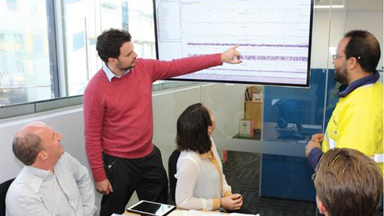
As a CAD user, how keen are you to have your every move watched? You have always understood that your boss wants you to be as productive as possible, but how you did so was up to you. Unless you had a boss from hell, they were not looking over your shoulder. You could use the Undo command or use the Esc or backspace key as often as you pleased. No one would know of your teeny missteps.
Image: ScienceSoft
The times, they are a-changing. Productivity tracking is a thing now. Last week, two articles appearing the Wall Street Journal about companies monitoring employee activity through tracking software and notifying HR. More on that later.
CAD is No Exception
I am reminded of a conversation months ago with a CAD company executive about AI. He let it drop that his company had been collecting and analyzing user data for years. And they are about to step it up. Data about user activity was collected while they were using the company’s cloud-based CAD product. The CAD product was to be “instrumented.” That meant that whatever users did with it was a matter of record and it would be kept with the company so it could be analyzed. The executive tries to be reassuring: the users’ proprietary design is at no risk; they are merely getting feedback on how commands are used in the hope of improving them.
How can anyone collect your data without your permission? They can because you unwittingly gave them permission. You may not remember the fine print because you didn’t bother reading it. I do it all the time. I’m always in a hurry to install the software or one of its updates. That fine print I never read constituted an EULA or end user license agreement?
Unless you are running open-source software, freeware, or custom code, you have signed off (checked off, most likely) on an EULA or a Terms of Service. Not having read one or wanting to, I call on the all-knowing ChatGPT and my suspicions are immediately confirmed: “Improving user experience” and “analytics and development” are two of the five rights I have probably granted to hundreds of software companies over the years, including many CAD programs.
What gives software companies the right to monitor the usage of the software?
EULA and Terms of Service. EULAs define the terms under which users can use the software, often including clauses that allow companies to collect data about software usage. This data can encompass general usage statistics, error reports, and user behavior, depending on the agreement’s specifics.
Anti-Piracy Measures: Monitoring helps detect unauthorized or pirated versions of software. By tracking license validation and access patterns, companies can ensure only legitimate users access the software.
Improving User Experience: Usage data enables companies to understand user interactions, identify popular features, and detect issues, guiding updates and new feature development to enhance usability.
Security: Some software includes monitoring to detect unusual usage patterns that could indicate security risks, such as unauthorized access attempts.
Compliance and Audits: Companies operating under regulatory standards may monitor software use to ensure compliance, especially when handling sensitive data.
Analytics and Development: Usage data allows companies to analyze trends, guide research and development strategies, and inform decisions about feature development.
While all that seems benign and maybe even helpful, it raises the questions “Who owns the data?” and “What can’t they do with the data?” And specifically, to our original concern, can they share the individual user and usage data with your boss? What rights do users have? Since users don’t typically pay for the software they use, I fear the answer would not be too reassuring.
In a world where technological and engineering advancements shape daily life, the importance of collaboration and effective communication among engineers is often overlooked. Renowned engineer and academic James Trevelyan (Professor Emeritus, University of Melbourne) and author (The Making of an Expert Engineer) offers fresh insights into how collaboration, communication, and a holistic approach to engineering practice hold the key to success in modern engineering. Trevelyan’s journey across diverse environments, from robotics and automation to on-the-ground work in challenging locales like Pakistan, has equipped him with a unique perspective on the industry’s challenges and the profound impact of soft skills on engineering success.
From Tinkering to a Trailblazing Career in Engineering
Trevelyan’s journey began with a fascination for mechanics. From his early years, he was captivated by taking things apart and understanding their inner workings. Engineering, he reflects, was not a deliberate career choice but rather an innate calling. His academic and professional career, however, revealed the many intersections between engineering, collaboration, and the cultural factors that shape them.
Unlike the isolated world of academia, Trevelyan’s dual experiences in academia and industry exposed him to the anti-collaborative tendencies prevalent in academic settings. Collaboration in academia, as Trevelyan noted, is often perceived as akin to cheating, where solo achievements are more valued than teamwork.
“One thing I’ve discovered is that academia tends to be an anti-collaborative environment. The most successful academics have often adapted to this culture,” he explained. This approach, however, is at odds with the reality of engineering, where collaboration often determines the success or failure of large-scale projects.
The Social Media Effect on Productivity and Communication
In an era dominated by instant messaging and social media, Trevelyan expressed concerns over the impact of digital communication on trust and teamwork. According to him, while texting and emails offer rapid communication, they often lack the nuance required for effective collaboration. “Text communication undermines trust and collaboration,” Trevelyan explained, alluding to studies from the 1950s that highlight the significance of face-to-face interaction. The reluctance of younger engineers to pick up the phone or meet in person, preferring emails instead, is a trend that he believes hampers effective collaboration.
He recounted an early experience where he was told to get feedback on a paper but he dreaded the thought of having to compile responses from 400 people. He emailed then all but put critical information in an attachment, knowing most would overlook it. The exercise demonstrated the lack of time people are willing to put into digital communication and how easily important messages get lost in the noise. Trevelyan emphasizes the need for engineers to develop communication skills that go beyond the digital realm to foster genuine collaboration.
Cultural Challenges in Engineering: Lessons from Pakistan
Trevelyan’s experiences in diverse cultural settings provided him with a deeper understanding of engineering’s social dimensions. His time in Pakistan, for example, highlighted how local customs and collaboration styles influence engineering outcomes. Pakistan’s inexpensive labor costs, he thought, could make certain projects more affordable there. However, he quickly realized that cultural and collaborative factors, such as a lack of transparent communication, resulted in higher costs and reduced efficiency. In Pakistan and similar settings, the reluctance to share information openly hampers collaborative efforts, often leading to subpar engineering results. Plus, there was rubbish everywhere, he says.
He observed that while engineers in Pakistan and India receive world-class education, they often struggle to replicate their success in their home countries due to the different cultural approaches to collaboration. Trevelyan advocates for teaching collaboration explicitly within engineering curricula, as opposed to merely assuming it will develop naturally through group work. His experiences underscore the need for engineers to adapt to cultural nuances, while emphasizing the universal necessity of open communication.
Collaboration as a Catalyst for Value Creation in Engineering
One of Trevelyan’s most compelling insights is his perspective on collaboration as a driver of value creation in engineering. Contrary to the common belief that communication skills are ‘soft’ and lack tangible impact, he argues that poor collaboration is a primary reason for the high failure rate of engineering projects.
“Poor collaboration is costly. Major projects fail 4 out of 6 times, and one in six loses all investor money,” he noted, citing examples where inadequate teamwork led to substantial financial losses. For instance, a nickel refinery project that cost $2.5 billion was ultimately sold for a fraction of its value due to collaboration failures.
Trevelyan believes that encouraging engineers to recognize the financial impact of collaboration could foster a more balanced approach in the profession. He points out that while technical skills remain critical, the ability to collaborate effectively is equally vital to project success. This message is particularly important in an industry that often prioritizes technical training over interpersonal skills, a gap Trevelyan believes companies should address through professional development programs focused on collaboration.
Communication Versus Collaboration: A Nuanced Distinction
In Trevelyan’s view, while communication is essential for collaboration, the latter requires a more in-depth skill set. Effective collaboration is rooted in active listening, a skill Trevelyan argues is not sufficiently emphasized in engineering education. Engineers spend approximately 25% of their time listening, he noted, yet few are trained in effective listening techniques.
He recalled suggesting that universities teach listening skills to engineering students, only to be met with surprise, as academics assumed students develop listening skills naturally from lectures. However, Trevelyan’s observations suggest otherwise, as students often forget most of what’s said in lectures within minutes. Trevelyan advocates for intentional training in listening and other collaborative skills, emphasizing that the ability to understand and synthesize verbal information is crucial in engineering.
The Business Case for Collaboration Training in Engineering
Despite the lack of emphasis on collaboration skills in many companies, Trevelyan argues that the financial returns on improved teamwork are substantial. Some Australian companies have begun investing in professional skills training for engineers, recognizing the need for effective collaboration alongside technical expertise. However, engineers often prioritize technical training, believing it to be more instrumental for career advancement. Trevelyan points out that while technical prowess remains important, companies that cultivate collaborative skills among their engineers tend to achieve better outcomes.
For engineers who lack access to formal training programs, Trevelyan recommends his books as resources for practical collaboration techniques. He highlights three core activities essential for engineering value: value creation, value delivery (where collaboration plays a critical role), and value protection. These principles, he believes, are central to successful engineering projects and can be the difference between a project’s success or failure.
Embracing Imperfection in Engineering Practice
One of Trevelyan’s more nuanced insights addresses the balance between perfectionism and pragmatism in engineering. While engineers often strive for flawless results, Trevelyan encourages a more pragmatic approach, focusing on value creation for clients. In his experience, clients who see tangible value are more likely to grant engineers the time and resources to achieve high-quality outcomes.
He illustrated this point with an anecdote about a project in Australia to develop robots for shearing sheep. Though the project did not result in a commercial product, it changed the industry by demonstrating that such a technology could exist, ultimately impacting shearers’ demands. This example underscores Trevelyan’s belief that engineers should focus on delivering value in ways that address clients’ needs, even if the initial outcome is not technically perfect.
Simple Solutions and Experiments: Speeding Up Engineering Processes
Trevelyan also advocates for simplicity in engineering solutions, sharing that simple experiments often yield valuable insights more efficiently than complex simulations. For instance, during the development of a prototype air conditioner, Trevelyan found that quick experiments provided more reliable data than computational simulations, leading to significant design improvements.
This hands-on approach not only saves time but also helps engineers understand the physical realities of their designs. Trevelyan recounts encouraging a young engineer to conduct simple experiments with thermocouples, enabling him to grasp complex temperature changes more intuitively. In Trevelyan’s view, simple, empirical experiments are an invaluable tool for learning and refining engineering practices.
Concluding Thoughts: The Future of Engineering in a Collaborative World
As engineering continues to evolve in an increasingly interconnected world, Trevelyan’s insights highlight the need for a renewed focus on collaboration and communication within the profession. His experiences emphasize that effective engineering goes beyond technical expertise; it involves understanding cultural contexts, mastering communication skills, and embracing collaboration as a cornerstone of project success.
In a profession that is often measured by technical output, Trevelyan’s message is a call to engineers to recognize the value of interpersonal skills, adaptability, and the simple power of collaboration. As the engineering landscape becomes more complex, his advice offers a blueprint for professionals looking to navigate and succeed in a field where both technical and soft skills are essential for lasting impact.
This article is based on an interview with Aaron Moncur for the Being An Engineer podcast.