Tag: Collier Aerospace

  • Radia Selects Collier for WindRunner Structural Sizing

    Radia Selects Collier for WindRunner Structural Sizing

    Artist rendering of the WindRunner airframe model showing optimization zones in HyperX software interface. Image Collier Aerospace Corp.

    NEWPORT NEWS, VA, Feb 27, 2025 – Collier Aerospace Corp., developer of the HyperX CAE solution, announced that Radia, Inc. selected its design and analysis software for the structural sizing of WindRunner – the world’s largest aircraft. Structural sizing is the critical process of determining the size and weight of primary aircraft structures.

    Radia is developing the WindRunner aircraft, an outsized aerial logistics platform designed to efficiently and effectively deliver the world’s considerable cargo, such as wind energy turbine blades, spacecraft, satellites, defense cargo, airplanes, and large commercial payloads. WindRunner solves transportation bottlenecks with its ability to fly cargo up to the length of a football field and land on semi-prepared dirt runways as short as 1,800m (6,000 ft) when required.

    Collier Aerospace’s software and services help Radia’s engineering and design teams optimize and accelerate sizing for the massive aircraft’s airframe and efficiently evaluate and analyze many different design configurations under rigorous time and cost pressures.
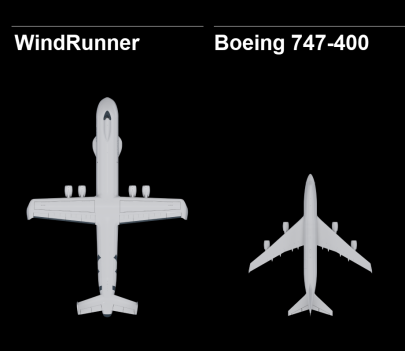
    Aircraft size comparison of the WindRunner and a Boeing 747-400. Image credit Radia.

    “Using Collier’s technology, we can create and analyze design concepts in hours and automate the time-consuming process of evaluating hundreds to thousands of load cases,” said Mark Lundstrom, founder and CEO of Radia. “Collier’s software helps us efficiently evaluate design options and optimize WindRunner’s weight and structural performance in support of its critically important mission.”

    Radia began the WindRunner project in 2016 and brought in Collier Aerospace at an early stage as a software provider and engineering consultant. To support the design process, Radia used Collier’s methodology for structural sizing and analysis. The team conducted configuration assessments of the wings, fuselage, ribs, spars stringers, and other parts made of composite and metal. Radia leveraged the tool’s automated sizing capabilities to account for unusual variables such as the huge size and capacity of the unpressurized fuselage.
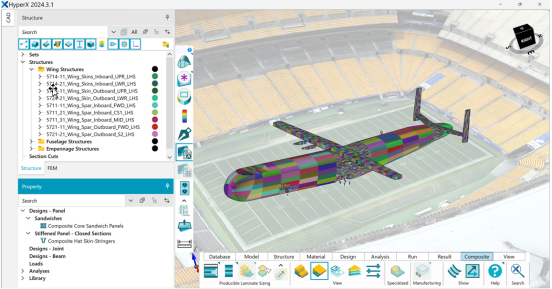
    Artist rendering showcasing the WindRunner aircraft, approximately the length of a football field (356 ft), shown in HyperX software interface. Image Collier Aerospace Corp.

    HyperX software automates stress analysis and design. It performs rapid structural sizing, lightweighting, and margin writing for all load cases. The software also helps ensure the producibility of a composite part by creating a design that is optimized for manufacturability. It reduces schedule time by speeding up the engineering cycle and shortening the U.S. Federal Aviation Administration (FAA) and European Union Aviation Safety Agency (EASA) certification processes.

    “It’s been a thrill to work with Radia on its breakthrough WindRunner aircraft and contribute to its extraordinary mission,” commented Craig Collier, professional engineer and CEO of Collier Aerospace. “This collaboration brought together the vision of the Radia team and our collective deep knowledge and experience in aerospace structural engineering. We contributed to the success of this design project by providing guidance on our software’s capabilities. We can’t wait to see the final result of this groundbreaking design when WindRunner makes its maiden flight.”

    About Collier Aerospace

    Founded in 1995, Collier Aerospace Corporation specializes in developing structural analysis and design optimization software for the aerospace industry. Their flagship product, HyperX, assists engineers in performing rapid stress analysis and structural sizing for both composite and metallic airframes, aiming to reduce weight and expedite certification processes. Headquartered at 760 Pilot House Drive, Newport News, Virginia, USA, the company serves sectors including space launch vehicles, commercial aviation, business jets, and urban air mobility. As of 2025, Collier Aerospace employs 31 professionals. While specific annual revenue figures are not publicly disclosed, the company has secured funding through grants and private debt financing. Notable clients include NASA, Boeing, and Bell Helicopter, reflecting the company’s significant role in advancing aerospace structural engineering.

  • X-59 Aircraft Gains Edge with Collier Aerospace’s Analysis Software

    X-59 Aircraft Gains Edge with Collier Aerospace’s Analysis Software

    NEWPORT NEWS, VA, Jan 9, 2025 – Collier Aerospace Corp. has announced that its design and analysis software was chosen by Swift Engineering, Inc., for structural sizing, analysis and test validation of the low-boom X-59 aircraft’s nose cone. This experimental aircraft from Lockheed Martin Skunk Works is part of the Quesst (Quiet Supersonic Technology) mission of U.S. National Aeronautics and Space Administration (NASA) to quiet loud sonic booms. Swift Engineering was contracted to build and perform structural analysis and certification testing for the X-59’s distinctive, 35 ft.-long nose cone, designed to control aerodynamic pressure waves (shock waves), that form at the sharp nose tip during supersonic flight, resulting in quieter sonic booms.

    The X-59, a unique experimental aircraft from Lockheed Martin Skunk Works, is part of the Quesst (Quiet Supersonic Technology) mission of U.S. National Aeronautics and Space Administration (NASA) to quiet loud sonic booms.
    Photo Credits: Lockheed Martin / NASA

    Collier Aerospace’s software enabled Swift Engineering to remove mass that reduced the nose cone’s weight by over 25 percent while maintaining dimensional stability; evaluate the design for a wide range of load cases; and provide detailed stress reporting to support part release and fabrication. The company also used the software to perform detailed analyses, supporting structural testing substantiation of the structural design.

    Collier Aerospace’s design and analysis software was chosen by Swift Engineering, Inc., for structural sizing, analysis and test validation of the X-59 aircraft’s nose cone.
    Photo Credits: Lockheed Martin / NASA.

    “The Collier Aerospace software played a critical role throughout this high-visibility project to design, engineer and build the X-59 nose structure,” said Bill Giannetti, technical consultant to Swift Engineering. “At the outset, when the team from Skunk Works explained how important lightweighting was, I had so much confidence in the software that I was convinced we would remove 100 pounds from the nose cone. However, we surpassed that goal by achieving a significant weight savings of over 25 percent on the nose cone structure.”

    Giannetti added, “We were able to iterate the structural sizing software with our finite element analysis solver, which enabled weight reduction through structural optimization and rapid load path convergence. Once the system was set up, we could literally watch the mass come out of the nose structure, while meeting all the traditional aerospace failure criteria simultaneously. It’s a fantastic software tool.”

    Meeting Rigorous Requirements

    To lower the weight of the approximately 400-lb. preliminary design, that specified graphite/epoxy composite and a honeycomb-core sandwich structure, Swift Engineering’s team removed unnecessary plies, simultaneously optimizing the structure for stress and stability. The Collier Aerospace software enabled the team to evaluate design alternatives by considering trade-offs in ply-layup schedules and core panel and edge band thicknesses, and then assess the change to the section stiffness and deflection.

    Swift Engineering used the full capabilities of the Collier Aerospace software for this unique aircraft nose structure, extending beyond preliminary sizing and optimization to include conducting detailed laminate strength analysis using design allowables derived from testing. The software enabled the company to deliver the nose cone ahead of schedule and under budget.

    HyperX software automates stress analysis and design. It performs rapid structural sizing to all load cases, lightweighting and margin writing. The software helps ensure the producibility of a composite part by creating a design that is optimized for manufacturability. It reduces schedule time by speeding up the engineering cycle and shortening the U.S. Federal Aviation Administration (FAA) and European Union Aviation Safety Agency (EASA) certification processes.

    Example of HyperX/HyperSizer Sizing Results for Margins of Safety.

    From Boom to “Thump”

    The goal of the X-59 aircraft, which is expected to make its first flight in 2025, is to help establish an acceptable noise standard for commercial supersonic flights over land, potentially resulting in U.S. and international regulators lifting a five-decade-long ban that was imposed due to loud sonic booms. Attributing to its unique geometry, particularly the elongated nose cone, the X-59 is expected to generate a barely audible thump rather than a boom, reducing noise impacts.

    “We’re grateful that our software helped Swift Engineering achieve success with the X-59 nose cone and met the high expectations of Lockheed Martin Skunk Works,” commented James Ainsworth, vice president, Engineering Services, Collier Aerospace. “The high level of credibility that our solution has earned, and its powerful sizing and analytical capabilities, were key factors in Swift’s decision to choose our software. We’re looking forward to the X-59’s first flight.”

    Source: Collier Aerospace