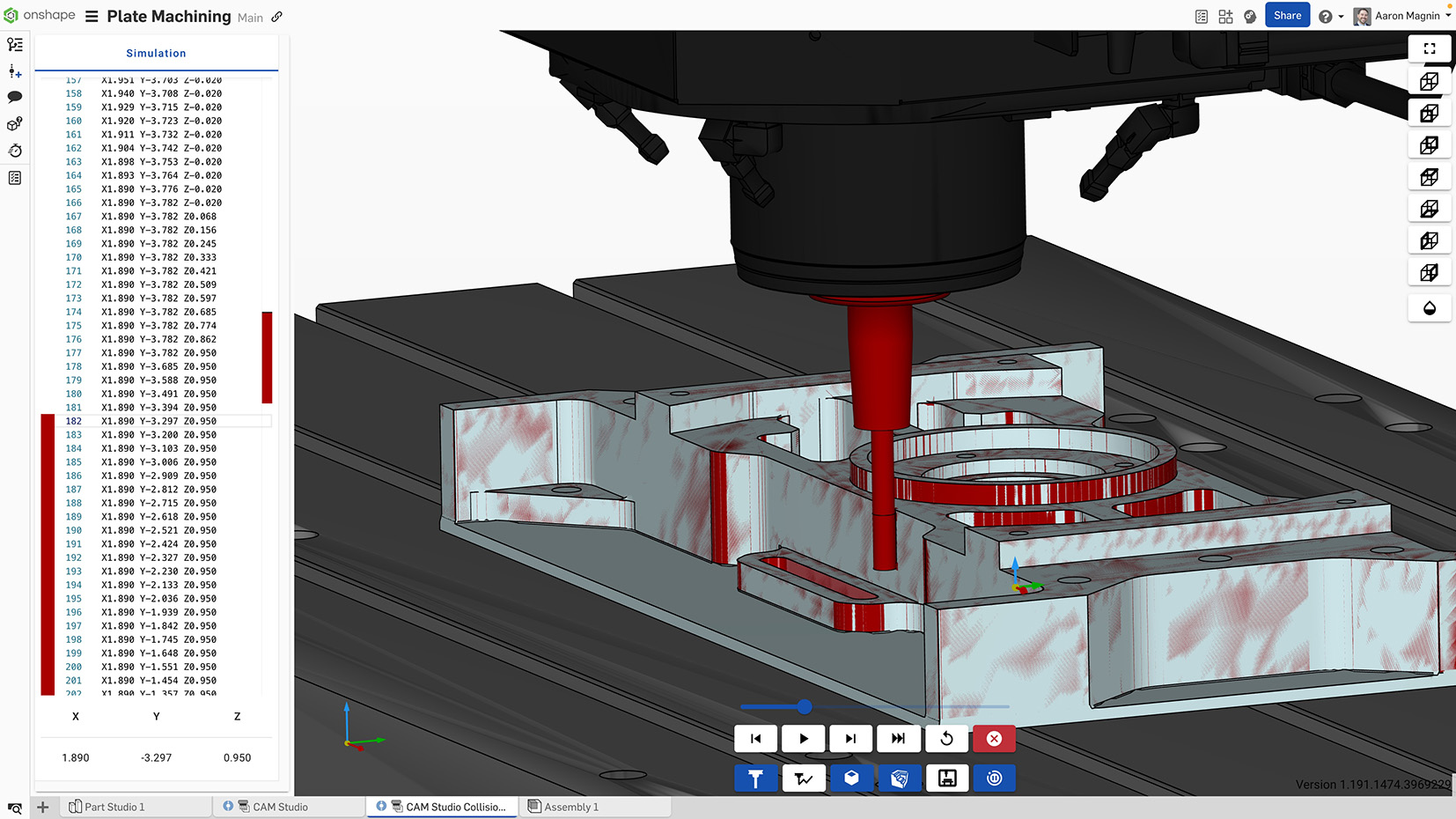
BOSTON, MA, Feb 12, 2025 – PTC has announced the launch of Onshape CAM Studio Beta, which integrates CAD, CAM and product data management (PDM) to give design and manufacturing teams the opportunity to plan, simulate, and collaborate on machining processes.
This release offers a complete design-to-manufacturing solution, enhancing productivity and creating new opportunities for leading manufacturing brands across the globe.
“With the release of CAM Studio directly into Onshape’s cloud-native platform, users gain built-in version control and centralized storage for their manufacturing strategies,” commented David Katzman, general manager of Onshape and Arena at PTC.
“This ensures seamless collaboration, eliminates the risks of file-based workflows, and provides unmatched traceability throughout the design-to-manufacturing process. CAM Studio reinforces our commitment to empowering teams with tools that enhance productivity and drive innovation.”
CAM Studio supports 2.5 and basic 3-axis machining, with the common manufacturing strategies and machines. For users with advanced manufacturing needs, CAM Studio advanced will offer enhanced capabilities, including advanced 3, 4 and 5-axis machining strategies.
Other features and benefits of Onshape CAM Studio include:
Access to the latest manufacturing information faster, while utilizing Onshape’s built-in PDM functionality for G-code and tooling strategies
Streamlined communication and easy sharing between CAD designers and manufacturing engineers
All stakeholders work from a single source of truth, saving time and money while also reducing manufacturing errors
No additional software installations, licensing costs or administrative costs
Cloud-native accessibility anytime, anywhere
CAM Studio is available to Onshape users who are subscribed to the Professional and Enterprise plans.
Source: PTC
About PTC
PTC Inc., founded in 1985 and headquartered in Boston, MA, is a software company specializing in product lifecycle management (PLM), CAD, augmented reality (AR), and Internet of Things (IoT) solutions. Serving industries such as aerospace, automotive, electronics, and industrial equipment, PTC’s technologies are utilized by 95% of Fortune 500 discrete manufacturing companies. As of September 30, 2024, PTC Inc. supports more than 30,000 customers globally. As of February 10, 2025, the company has a market capitalization of $20.3 billion. PTC employs around 7,500 people globally.
CHICAGO, IL, Feb 6, 2025 – RRD is investing in robotic technologies and advanced HP digital print presses to upgrade its Austell, GA facility into a modern commercial print hub.The investment doubles the site’s workforce and sets a benchmark for rapid, high-volume digital production and automation.
“RRD is driven by a passion for innovation,” said Craig Roberton, president of commercial print, RRD. “Our latest investment exemplifies a commitment to lead the industry and stay at the forefront of emerging technologies and trends that benefit our clients. We’re not just working to enhance RRD’s capabilities — we’re empowering our clients to achieve measurable results and thrive in an ever-evolving industry.”
The investment enables RRD to deliver high-speed, high-quality, variable print-on-demand services to meet evolving client demand and anticipated industry shifts. The Austell site features HP’s new Indigo 120K Digital Press and PageWide Advantage 2200 with HP Brilliant Ink. The equipment is designed to empower high-volume production businesses by delivering speed, reliability, and cost-efficiency. The equipment also elevates RRD’s capabilities and delivers benefits such as:
higher ROI customer acquisition products
hyper-personalization, which enables brands to tailor messaging to each consumer based on their unique relationship with the brand
productivity and quality that rival offset printing
added versatility for short, medium and long runs on a variety of substrates
accelerated job production with AI-driven automation
Pantone color matching to ensure brand consistency
aqueous and ultraviolet coating options
increased sheet and saddle stitch booklet options
minimized waste
RRD’s Austell location will also be among the first commercial print manufacturing facilities in America to implement industry-first robot technology.
RRD Austell Facility. Image: RRD
Through an ongoing partnership with HP, RRD will deploy two autonomous mobile robots designed specifically to bolster efficiency. The robots feature intelligent software that communicates with HP Indigo presses. The communication allows for interfacing with presses, manages pallet locations in the warehouse and near presses and finishers. The robots can load and unload media directly into and out of presses, streamline workflows, eliminate safety risks, and keep the presses continuously operational to bring client projects to life faster.
“Our longstanding and deep partnership with RRD demonstrates our mutual commitment to delivering innovative solutions that create new business opportunities in an industry where speed and personalization are increasingly important,” said Oran Sokol, VP & global head, Strategic Accounts, HP.
RRD’s Austell facility is expanding production space and introducing new features for clients. These upgrades include rooms where customers can observe the production process firsthand. The improvements are set to finish in early 2025, with more digital updates planned at other RRD locations in the coming years.
About RRD
R.R. Donnelley & Sons Company (RRD), founded in 1864, is a global provider of multichannel solutions for marketing and business communications. Headquartered at Chicago, IL, RRD offers a comprehensive portfolio of proficiencies, including commercial printing, logistics, supply chain management, and digital marketing services. The company serves a diverse range of industries, such as retail, financial services, healthcare, and technology, assisting organizations worldwide in creating, managing, and executing their multichannel communications strategies. As of 2022, RRD reported net sales of $5.37 billion. The company employs approximately 28,000 individuals across various locations globally.
WALDKIRCH, Germany, Jan 31, 2025 – SICK has announced the acquisition of the Dutch technology company Accerion. Accerion specializes in AI-based image processing with a focus on positioning technologies for mobile robots. Autonomous Mobile Robots (AMR) are primarily used in logistics and manufacturing. They improve efficiency by automating tasks in warehousing, intralogistics, manufacturing, and other industries. With the acquisition of Accerion, SICK will offer a complete solution portfolio of positioning solutions.
Innovation Hub for Software-Driven Localization
Accerion was founded in 2015 in the Netherlands and has established itself as a tech startup specializing in AI-based image processing for the positioning of autonomous mobile robots. With the software-driven positioning solution “Triton”, Accerion introduced the world’s first industrialized, infrastructure-free localization solution for floor structures based on camera technology for mobile robots. Since 2021, SICK has been partnering with Accerion to support industrial customers worldwide in the precise localization, positioning, and navigation of mobile robots.
Accerion Now Part of the SICK Group
With the acquisition, the entire product portfolio and the Accerion team with technology and sales experts, fully transitioned to SICK on January 16, 2025. The product development of the new SICK subsidiary “SICK Accerion B.V.“ will continue at the current location in Venlo, Netherlands.
SICK Expands Software Portfolio for Autonomous Mobile Robots
Dr. Niels Syassen
“We are very pleased to welcome the Accerion team to SICK and to further strengthen our software portfolio for autonomous mobile robots for the future,” says Dr. Niels Syassen, executive board member for Technology & Digitalization at SICK. “The market for sensor solutions for autonomous mobile robots offers enormous growth potential, as the demands on industrial companies for an efficient supply chain in terms of throughput, availability, flexibility, and safety are steadily increasing. To best support customers worldwide in their automation projects, we are further developing our own sensor solutions and investing in new technologies,” adds Dr. Niels Syassen.
Vincent Burg
Vincent Burg, CEO of Accerion, says: “With our dedicated team, we built Triton, a cutting-edge localization solution, entirely from the ground up. Today, Triton delivers high-performance localization for thousands of robots around the globe. Our close collaboration with SICK has shown how perfectly our products and cultures complement one another. We are thrilled to officially join the SICK family, where we can leverage this synergy to scale localization solutions worldwide.”
Autonomous Mobile Robots – a Global Growth Market
The global market for Autonomous Mobile Robots is valued at about four billion euros. With growth rates exceeding 15 percent, industries like intralogistics focused on efficiency are increasingly adopting these robots. Advanced sensors and software for navigation, localization, and positioning allow mobile robots to move accurately and safely in changing environments. When working near people, it is critical for autonomous robots to detect surroundings and human presence.
About Accerion
Accerion is a technology startup based in Venlo, Netherlands, established in 2015 by Willem-Jan Lamers. The company specializes in developing advanced, infrastructure-free positioning technology for mobile robots and automated guided vehicles (AGVs). Their innovative sensors provide sub-millimeter accuracy, enabling precise navigation in dynamic environments without external infrastructure. This technology is particularly beneficial in industries such as warehousing, manufacturing, and logistics, where automation and efficiency are paramount. As of 2025, Accerion operates in 13 countries, serving key customers across multiple markets.
About SICK
SICK AG, founded in 1946 by Dr. Erwin Sick, is a global provider of sensor-based solutions for industrial applications. Headquartered in Waldkirch, Germany, the company specializes in intelligent sensors and systems that improve automation across various sectors, including factory, logistics, and process automation. SICK’s product portfolio comprises of photoelectric sensors, safety light curtains, laser scanners, and identification solutions like barcode scanners and RFID readers. These technologies are integral to industries such as automotive, electronics, food and beverage, and packaging, where they ensure efficient process control, safety, and environmental protection. With nearly 60 subsidiaries and numerous agencies worldwide, SICK employs over 12,000 people and reported a group revenue of €2.3 billion in the 2023 fiscal year.
CHARLOTTE, NC, Jan 29, 2025 – SPX FLOW has collaborated with Siemens to highlight cutting-edge digital twin technology at the MxD (Manufacturing x Digital) center in Chicago. A premier hub for innovation in manufacturing, MxD is driving advances across industries such as food and beverage, chemicals, and batteries.
At MxD, SPX FLOW and Siemens are demonstrating the transformative potential of digital twin technology. The technology is enhanced by industrial 5G connectivity and modular production using software-defined module type package (MTP) concepts, showcased through an automated mixing tank with an associated digital twin.
The collaboration combines SPX FLOW’s fluid processing solutions (including mixers, pumps and valves) and expertise with Siemens’ IoT connectivity solutions and computational fluid dynamics (CFD)simulation capabilities to create a digital twin (a precise virtual replica of the physical systems) of an autonomous mixing tank concept. This enables users to design, test, and optimize fluid systems virtually, mitigate risks, improve efficiency and accelerate innovation.
SPX FLOW supports Siemens in showcasing how virtual simulation can transform production. By creating a digital twin of a flexible, autonomous process, manufacturers can improve production, verify throughput, and adapt easily than with traditional fixed production lines. This method also enables continuous mixing of materials or ingredients while an autonomous mobile robot (AMR) navigates the plant, ensuring maximum production capacity and consistent quality.
Image: A Guide to Fluid Mixing, J.Y. Oldshue, et al.
“Our innovative fluid technologies combined with simulation-based digital twins and AI-driven modeling enables us to deliver faster, customer-focused solutions,” said Tyrone Jeffers, SPX FLOW vice president of global manufacturing and supply chain. “Together with Siemens, we are prioritizing flexibility, efficiency, and sustainability, paving the way for a new era of manufacturing excellence.”
CFD modeling and IoT conditional monitoring support SPX FLOW’s product development by:
Accelerating Innovation: Reducing modeling time while improving precision.
Improving Efficiency: Refining designs with enhanced flow analysis.
Integrating Seamlessly: Aligning digital twins with real-world applications.
Smart Products: Leveraging IoT conditional monitoring to optimize equipment performance and enable predictive maintenance.
“This collaboration is a win for us and a huge win for our industrial customers,” said Del Costy, managing director, Americas, Siemens Digital Industries Software. “Working together with SPX FLOW and harnessing the power of live connections between the physical and digital worlds in digital twin models, we are helping customers to achieve faster time to market, optimize system performance, reduce costs and resource usage, and deliver tailored, application-specific solutions to meet their unique needs.”
About SPX FLOW, Inc.
SPX FLOW, Inc., headquartered in Charlotte, NC, is a leading provider of process solutions for nutrition, health, and industrial markets. The company was established in 2015. It specializes in engineering, designing, and manufacturing a wide range of products, including pumps, valves, mixers, filters, air dryers, homogenizers, hydraulic tools, separators, and heat exchangers. These solutions serve industries such as food and beverage, power and energy, chemical processing, compressed air, mining, and other industrial sectors. Operating in more than 25 countries with a workforce of approximately 3,900 employees, SPX FLOW has a global presence and serves customers in over 140 countries. The company is recognized for its innovative and sustainable solutions that improve the world through advanced process technologies.
About Siemens Digital Industries Software
Siemens Digital Industries Software provides comprehensive solutions for digital transformation, offering software and services that enable companies to improve product design, manufacturing, and operational processes. It serves a wide range of industries including automotive, aerospace, industrial machinery, electronics, and consumer products. Siemens Digital Industries Software has contributed towards innovation in manufacturing and product lifecycle management (PLM). The company is headquartered in Plano, TX, and is part of Siemens AG.
PLANO, TX, Jan 28, 2025 – Siemens Digital Industries Software announced that it has been named a leader in the IDC MarketScape: Worldwide Manufacturing Execution Systems (MES) 2024–20251 vendor assessment. The IDC MarketScape report evaluates software providers in the MES market serving the manufacturing industry.
“The recognition of Siemens as a manufacturing execution system leader in the IDC MarketScape report, we believe, highlights our fast pace of innovation to provide our customers with world-class integrated manufacturing execution systems technology,” said Tobias Lange, senior vice president manufacturing operations management, digital manufacturing, Siemens Digital Industries Software. “Our continued commitment to delivering open, configurable, easily deployable and inherently scalable software is truly benefitting customers across the globe.”
Siemens’ Opcenter at a glance
Opcenter is Siemens’ software for MES, and with support for multi-plant architectures, it reduces the burden on regional IT teams and helps to lower overall Total Cost of Ownership (TCO). It seamlessly integrates with solutions from the Siemens Xcelerator portfolio of industrial software, including Teamcenter software for Product Lifecycle Management, Simcenter software for simulation, Insights Hub for data analytics, AX4 and Supply Chain Suite, and Tecnomatix software for factory simulation to bring new levels of agility and productivity to the shop floor.
To address the growing complexity of product and process management, disruptive technologies, supply chain volatility, and tightening margins, Siemens has introduced Opcenter X to empower small and medium businesses to embark on a progressive digital transformation journey through cloud technologies and accessing as software as a service (SaaS), which lowers the time and cost barriers for organizations to adopt MOM capabilities.
“The need for shop floor processes to coordinate with rapidly evolving value chains requires that MES work seamlessly with other enterprise and manufacturing-focused applications to ensure visibility from the shop floor to the top floor,” said Lorenzo Veronesi, associate research sirector, IDC manufacturing insights. “Innovation drivers such as cloud computing, edge analytics, the Industrial Internet of Things (IIoT), and artificial intelligence (AI), is significantly influencing the development of MES.”
About IDC MarketScape
IDC MarketScape is a vendor assessment tool in the information and communications technology (ICT) industry, It serves industries such as information technology, telecommunications, and consumer technology. It evaluates products, services, strategies, and potential for market success. This tool helps technology buyers with a 360-degree assessment of the strengths and weaknesses of both current and potential vendors. Established in 1964, IDC is headquartered in Needham, MA.
About Siemens Digital Industries Software
Siemens Digital Industries Software provides comprehensive solutions for digital transformation, offering software and services that enable companies to improve product design, manufacturing, and operational processes. It serves a wide range of industries including automotive, aerospace, industrial machinery, electronics, and consumer products. Siemens Digital Industries Software has contributed towards innovation in manufacturing and product lifecycle management (PLM). The company is headquartered in Plano, TX, and is part of Siemens AG.
1 IDC MarketScape: Worldwide Manufacturing Execution Systems 2024–2025 Vendor Assessment (doc # US51813624, December 2024)
CHARLOTTE, NC, Jan 27, 2025 – Volta Insite has announced a collaboration with Apolo to enhance its automated intelligence capabilities using generative AI. This partnership focuses on transforming how businesses track and address equipment performance, improving efficiency and minimizing downtime.
The collaboration brings generative AI capabilities into Volta’s AI framework, leveraging Apolo’s powerful AI platform that combines high-performance computing (HPC) resources, an enterprise-grade MLOps platform, and expert AI/ML consulting services. These AI-powered notifications will adjust based on the unique conditions of each piece of equipment at customer sites. They will provide clear, actionable insights to help improve operations. Using Apolo’s platform, Volta Insite is able to process large datasets, train machine learning models, and generate insights in less time, minimizing errors.
“We are thrilled to partner with Apolo to integrate generative AI into our platform,” said Denis Kouroussis, CEO of Volta Insite. “Apolo’s combination of HPC power, advanced MLOps tools, and expert consulting has elevated the scalability and relevance of our notifications, ensuring our customers receive precise, actionable insights in real time. It’s a major step forward in predictive maintenance.”
Volta Insite’s Electrical Signature Analysis solution has already redefined predictive maintenance by providing deep insights into equipment health. Its ability to detect issues ranging from belt degradations in mechanical systems to contactor-type faults and ground faults in electrical distribution systems sets it apart in the industry.
“Partnering with Volta Insite to integrate generative AI into their groundbreaking predictive maintenance technology is a game-changer,” said Bill Kleyman, CEO and co-founder of Apolo.us. “By combining their innovation with Apolo’s advanced AI platform, we’re setting a new benchmark for data centers, hyperscaler’s and critical infrastructure. This collaboration will redefine operational efficiency, reduce downtime, and unlock transformative potential across the industry.”
About Volta Insite
Volta Insite, founded in 2022 and based in Cornelius, North Carolina, provides AI-powered tools for real-time monitoring and predictive maintenance of electrical systems. Their InsiteAI platform analyzes data to detect potential problems early, helping prevent equipment failures. They serve industries including manufacturing, healthcare, hospitality, wind energy, oil and gas, entertainment, mining, cement, water treatment, hydro energy, airports, data centers, steel and metal, cryptocurrency mining, HVAC, chemical, and utilities. Volta Insite is known for improving electrical asset management, increasing efficiency, and minimizing unplanned downtime across multiple sectors.
About Apolo
Apolo, based in Fort Lauderdale, Florida, focuses on upgrading data centers for AI capabilities. The company provides a white-label platform that works directly with existing systems. Their solution includes an abstraction layer and orchestration for AI tools, allowing collocation and hybrid cloud providers to offer GPU-as-a-service near clients’ data. The setup avoids data migration and complies with security, privacy, and regulatory standards. Apolo serves data centers, businesses, and startups needing advanced AI and machine learning solutions. They deliver customized options to improve operations and support AI development.
TAIPEI, Taiwan, Jan 27, 2025 – Cincoze has launched the latest addition to the rugged computing – DIAMOND product line, the entry performance & compact industrial computer DC-1300 series. It packs enhanced performance and expansion flexibility in a compact 185 x 131 x 56.5 mm chassis. The new generation DC-1300 series can be equipped with an Intel Alder Lake-N processor, supports the essential I/O interfaces for industrial applications, and provides complete wireless transmission solutions (Wi-Fi, 5G, GNSS, etc.). The DC-1300 continues the legacy of the DC series for successful integration in space-limited industrial automation applications.
4.5X Performance and Multiple Storage Options
The new generation DC-1300 series supports the latest Alder Lake-N platform Intel Core i3-N305 processor, with computing performance of 4.5 times that of the previous generation. The DC-1300 supports up to 16GB DDR5 4800MHz in a single memory slot. It offers flexible storage options, such as 2.5-inch SATA HDD/SSD or Half-Slim SSD. Additionally, it supports expansion via the M.2 slot for NVMe SSD to meet the needs of different application scenarios.
Innovative Stackable Expansion Box Design
The DC-1300 has a set of native I/O interfaces, including LAN, USB, COM, and 4K DisplayPort, and can expand COM, DIO, display, and IGN functions through Cincoze’s exclusive CMI/CFM modules. Cincoze has launched a new Stackable Expansion Box (SEB) for the DC-1300 series. The SEB uses the built-in dual M.2 B Key slots to support I/O, CANbus, and Fieldbus modules. This design enhances its capabilities for smart manufacturing, transportation, energy management, and other applications.
Rugged, Compact, and Flexible Deployment
The DC-1300 series is compact (185 x 131 x 56.5 mm) and designed for space-limited factory automation applications. It supports various installation methods, including wall mounting, side mounting, and DIN rail mounting, for convenient and flexible deployment in machines, control cabinets, or automated guided vehicles. It supports wide temperature (-40 to 70°C) and wide voltage (9-48 VDC). It also complies with EMC standards (IEC 61000-6-2/4) and the US military shock standard (MIL-STD-810H) to ensure stable operation in harsh industrial environments.
About Cincoze
Cincoze was established in 2012 and is headquartered in New Taipei City, Taiwan. It specializes in the design and manufacture of rugged embedded computing systems tailored for edge computing and AIoT applications. Their product portfolio includes rugged embedded computers, convertible embedded systems, industrial panel PCs and monitors, and embedded GPU computers. These solutions serve industries such as manufacturing, intelligent transportation, railway computing, in-vehicle computing, warehouse and logistics, energy, kiosks, and security and surveillance. Cincoze has experienced rapid and steady growth, maintaining a compound annual growth rate (CAGR) of 40% for eight consecutive years. The company has expanded its global presence with facilities in the USA, China, and Germany, and a network spanning over 40 countries with more than 50 value-added partners.
ISLANDIA, NY, Jan 21, 2025 – Festo introduces its new valve terminal, the VTUX. The VTUX can serve as I/O, remote I/O, and decentralized I/O. These durable IP65/67-rated terminals can be placed anywhere on a machine to boost performance and speed up OEM installation. VTUX modularity results in less inventory and lower overhead costs. The VTUX is set to replace Festo’s legacy terminals.
The VTUX valve terminal
VTUX is both compact and lightweight, an advantage for end-of-arm tooling and conserving space on a machine or in a control cabinet. The terminal is built from a tough polymer, allowing use in welding environments.
The key to the VTUX’s flexibility is its modular design. For high flow rates up to 670 l/min, a high flow subbase is used and for space saving needs, the compact subbase. A single valve model can be used for both subbases, which simplifies ordering, stocking, and support. High flow and compact subbases of one or four valve positions can be mixed and matched on a terminal. VTUX terminals can have up to 128 valves with up to 128 solenoid coils. The VTUX also features vacuum capability.
The electronics side of the terminal offers the same flexibility as the pneumatics side by featuring mix-and-match modules. For example, users can add multiple analog or digital I/O modules, including I/O-Link. The modular concept continues through to the method of communication between controller and terminal. The choices include the new Festo Automation Platform (AP) for backplane speed communication in all top communication protocols. All AP-based modules appear to the control engineer to be under a single IP address that simplifies commissioning and allows smaller and less expensive PLCs to be specified. Additional communication modules include IO-Link, AP-I for decentralized I/O, and multipin connector.
VTUX terminals are assembled and tested at the Festo Regional Service Center in Mason, Ohio. They arrive ready for installation. As a key Festo product, VTUX parts are stocked worldwide to ensure quick replacements and reduce downtime. The modular design simplifies inventory, shortens training, and speeds up troubleshooting and repairs.
The moving assembly line has certainly proven its worth over the 100-plus years since Henry Ford introduced the industrial time-and-motion breakthrough in his Michigan automobile factory in 1913. The addition of robots (by GM in 1962) alongside human workers has further increased efficiency.
A Heitec engineer monitoring a robotic CT scan and analysis system as it inspects a manufactured component.
The success of the assembly line is tied to the quality of the components fed to it from production. As the complexity of modern vehicles has risen dramatically in recent decades, particularly in the case of electric vehicles (EVs), the value of pre-assembly quality checks at key stages during active production has become increasingly apparent. In addition to various methods of surface scanning, some of the leading automotive manufacturers (along with others in aerospace, energy and electronics) are using computed tomography (CT) to inspect inside components.
Examples of CT-scan-data analysis of an automotive part.
Germany’s luxury automaker, BMW, is doing CT scans of every engine housing in their iX EVs.
The iX is based on an independent platform, unlike the company’s other electric vehicles, However, it it uses the same drive unit (motor, inverter, transmission) known as HEAT (Highly-Integrated Electric Drive Train) that is employed in the other BMW models. Ensuring the consistency and quality of this valuable drivetrain is clearly a priority for the automaker.
How In-line CT Quality Inspection Works
During quality testing with in-line computed tomography (CT), an X-ray source emits radiation that penetrates objects and is attenuated depending on the material and geometry of the workpiece to be tested. A detector attached at the opposite side of the source creates a shadow image of the workpiece from the remaining radiation; the varying grey tones of the shadow images represent the differences in the nature of the test specimen. Control software then generates a 3D model of the object from the 2D X-ray image stacks. Finally, holistic analysis and visualization software is used to view and analyze the digital model from a variety of specific perspectives to either detect potential faults or to certify acceptable quality.
Robots and Scanners and Software—On the Line
At its Landshut, Germany, facility, BMW is using a combination of in-line robotics, CT scanning and detection, and analysis and visualization software, to inspect their HEAT e-engine housing during active production. The entire system was installed and integrated into their production line by Heitec, a global engineering solutions provider for a broad range of industries.
Heitec’s installation delivers a continuous-flow process in which a robot plucks an aluminum housing off the production line, deposits it on a platform that feeds it into a HeiDetect Inline CT scanner, then shifts to the other side of the scanner to retrieve an already-scanned component and moves that one back to the line. Each scan takes place in 50 seconds.
Post-scan, Heitec’s proprietary software quickly generates a digital model of each housing from the CT data, then transfers the model to Hexagon’s VGinLINE software for rapid segmentation and analysis. Viewable onscreen by engineers, graphic-and-colored alerts are automatically generated to call out any significant porosity, cracks, geometric inconsistencies, or other production or material flaws that deviate from BMW’s quality specifications.
Delivering Production Insights—at Speed
Christian Abt of Heitec
“Doing all this in the cycle time of the production line is the challenge,” says Heitec co-founder Christian Abt. “You have to speed everything up to stay within that time—or even several seconds less than that.”
Achieving this kind of fine-tuned industrial automation has become second nature to Heitec, which has been installing increasingly “smart” factory systems worldwide for more than 26 years. After completing his engineering degree, Abt first worked at the Fraunhofer Institute in Germany (“for a young engineer, a fantastic playground for robotics”). He left to co-found Heitec as robots were becoming a commodity, deciding to strengthen his young company’s automation offerings with the addition of CT scanning.
“Prior to that time, most CT was being used in the laboratory,” he says. “We saw an opportunity to bring these machines into real-world production, supporting the guys in blue jackets on the factory floor with our x-ray technology, our robots, and our knowledge of automation.”
“Manufacturing companies that are now coming to us for in-line CT have usually checked out all other possibilities but found no other solution that provides the level of quality assurance they are looking for,” says Abt. “They are demanding answers that work for them.”
Heitec customizes every installation to the specific industrial customer, sets up the robot(s) and CT scanner(s)—and then must deliver the promised rapid-inspection results. “If you’re familiar with using industrial CT in the past, you may remember hours for scanning and gigabytes of data to sift through for defects,” Abt says. “That’s not the case here in production—there’s no time for that kind of delay.”
The Secret’s in the Scan—and the Software
The solution to the time crunch? Employing lower-resolution industrial CT scans that need significantly less time to capture an image—plus Heitec’s scanner-integrated software designed to process this “less-heavy” information and reconstruct the component’s volume data into a 3D computer model. This data is then loaded into holistic analysis and visualization software that queries the digital model, employing sophisticated algorithms and, most recently, deep learning—to reliably identify, interpret and report potential quality issues despite the noisy images—within a much shorter time window.
“For the kind of advanced data processing software that would deliver the metrology results our customers were asking for, we found our way to Hexagon’s VGSTUDIO MAX and VGinLINE,” says Abt. “We had evolved from software developed for research to the situation where industry was asking for more standard and pre-qualified digital tools. Everyone was aware of VG software; it was, and is, the standard in CT software.
“The complete infrastructure of VGinLINE is a ready-to-use software package that allows us to easily integrate our own modules and functions, enabling us to combine accepted standards with flexibility. We just drop out a volume and VG starts to analyze it. This process is also easy to parallelize to more than one computer to speed things up in case the time for analyzing the data is slightly longer than the time to scan the part.”
The VG CT-data analysis and visualization software has undergone over a quarter century of evolution and development, with process automation and, most recently, deep- and machine-learning, increasingly being integrated into its offerings. Says Hexagon’s general manager for VG products, Dr. Daniela Handl, “The huge quantities of design and engineering data that can be captured by CT needs a holistic approach, coupled with robust computational capabilities, to be most valuable. Rapid results delivery is critical for engineers looking for real-time insights into production-line quality as well as how manufacturing-parameter variations might be affecting outcomes.”
Key to determining which data is significant in the scan of a component is the process of segmentation—the extraction of regions of interest (ROIs) from the 3D image data. Abrupt discontinuities in voxel grey-values typically indicate edges that define a region. By partitioning a scan into discrete regions, the software can more rapidly focus on and catalogue the characteristics of the voxels in each segment. Segmentation thus enables the processing of only the important portions of a dataset—which takes a lot less time.
Customizing Proprietary Solutions with Machine Learning
But how do you determine which segments are the important ones? Especially since, in a lower-resolution CT scan obtained on a production line, the less-crisp image slices can be more challenging to understand. This is where deep- and machine-learning, forms of artificial intelligence (AI), comes into the picture: using trainable algorithms, AI can be harnessed to process and make decisions based on noisy CT data as accurately as on hi-resolution data.
Advanced CT analysis software enables grey-value-based, shape-based, or machine-learning-based segmentation of 3D data. These defined regions of interest (ROIs) can be used to perform further analyses.
“Trainable” is the key word here. The algorithms compare what they see against an existing database of all known identifiable defects that have been customized to each manufacturer’s product geometries (which is where the “training” comes in). The algorithms “learn” to identify specific manufacturing flaws by interpreting what the less-crisp voxels show.
Over time, deep learning gets even better at what it does; by comparing what it sees against real-world product data for which the solution is known, it learns to recognize patterns and features and call out deviations from the norm. In this way, it can provide highly accurate snapshots of what’s actively happening on a particular production line—supporting confident decision-making about whether to accept or reject a part. This in turn informs production-variable changes, the effects of which can be captured, collated, and statistically examined. EV batteries are another area in which machine learning can be used in this way.
How to optimize this kind of AI methodology is what BMW is now exploring—as are forward-thinking manufacturers in other industries. Working closely under NDAs, with innovators such as Heitec and Hexagon, these companies are creating and curating their own internal data sets with which to train in-house deep learning systems.
“Training a deep learning system to one’s proprietary data understandably takes some time,” says Handl. “But it pays off by saving highly valuable time and resources on the production line.” Actionable insights into what’s happening on one’s own factory floor are contributing to the further evolution of smart manufacturing, enabling companies across many industries to identify ways to improve quality while making their products more competitive.
Sponsored content, source: Heitec. See Sponsor to get your article or news posted on ENGtechnica.