ZHONGSHAN, China, Jan 13, 2025 – SUNLU has unveiled its latest development – the FilaDryer E2, an optimum solution for efficiently drying and annealing engineering filaments. Addressing professionals and enthusiasts, the E2 is designed to handle high-performance materials, setting a new benchmark in filament management and post-processing.
Key Features
One-Touch Efficient Drying – The FilaDryer E2 is the first in the industry to achieve up to 110°C drying temperature. It is ideal for handling moisture-sensitive materials like PA and PC by drying at 90°C in just 2–3 hours, significantly improving efficiency. With a user-friendly one-touch drying function, the E2 automatically provides optimal drying settings for the most common filament types. The FilaDryer E2 features a dual-chamber insulation ensuring efficient, consistent and energy-efficient drying by trapping heat and blocking external moisture.
Powerful Annealing – The FilaDryer E2 is the first filament dryer capable of annealing 3D-printed parts. Annealing eliminates residual stress through consistent thermal treatment, thus, enhancing mechanical properties. This feature allows users to achieve superior strength, stability, and durability in the prints, particularly with engineering-grade materials like PA and PC.
Dry Bigger – The FilaDryer E2 accommodates up to one 3kg/2kg spool or two 1kg spools (maximum spool size: φ250mm×153mm). This makes it the ideal choice for users working with larger spools, providing the convenience of handling bulk materials without frequent spool changes.
Enhanced Safety – The FilaDryer E2 prioritizes user safety with a dual-layer insulation structure that maintains exterior temperatures below 60°C, even at its maximum drying temperature of 110°C. A high-temperature-resistant fan, a PTC heater, and an automatic power-off system safeguard the device during prolonged use.
The FilaDryer E2 represents SUNLU’s commitment to driving innovation in the 3D printing industry. Specially designed for the engineering filament market, it is available for preorder. The E2 delivers efficient, reliable engineering filament printing, unlocking endless possibilities for creators and professionals.
What has Greg Mark been up to since he sold his Markforged 3D printing company for $2.1 billion? Many things, one of which is developing Backflip, an AI-assisted design engine. After receiving $30 million in funding, Backflip announced that it has emerged from stealth mode.
In the announcement were claims that you could give Backflip a 2D image (a photo, sketch, illustration) and it would create a 3D model. Best of all, it could make a 3D shape from natural language prompts.
That would be genius, I thought. I admit to attributing genius to those who agree with me. I had been proposing text-to-shape to all who would listen. They said it couldn’t be done, not with large language models. LLMs, like ChatGPT, that are only able to give text answers. Math still eludes LLMs, so don’t expect calculations or shapes which are mathematically defined. Even if they could do math and shapes, the amount of prompting would be so lengthy and laborious that you could have created the part in CAD sooner.
But Greg Mark may not have been paying attention. He imagined an AI that produced a 3D shape when it was little more than a notion in the mind of a designer or engineer.
Backflip couldn’t have been more welcoming. All it requires is an email address to set up an account. For an unspecified trial period, it is free to use. You have unlimited usage (credits). Clearly, the intention is to get attention and users while the company ramps up features and capabilities and works out the kinks.
The program runs on the cloud through a web browser. I used Chrome. There is nothing to download. Consequently, you can use it immediately and on any device.
The interface is clean and uncluttered, with a text box to accept a prompt and buttons for importing images or sketching. Most of the screen is dedicated to the display of images and shapes. This is not a programmer’s tool that has just emerged from the lab. In fact, if all Backflip had to do was make rendered images, it could pass for a finished finished product.
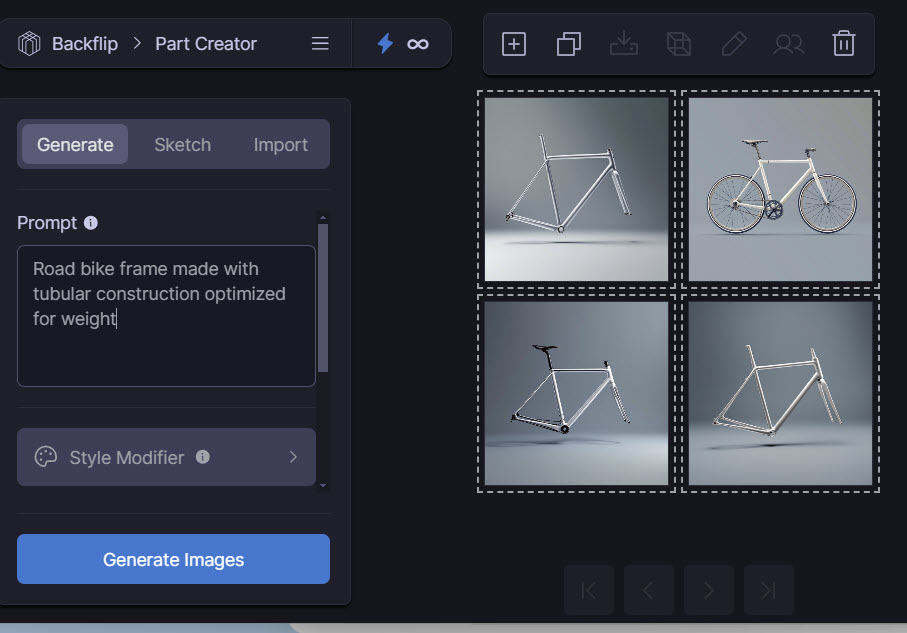
I get started by asking for a simple shape with minimal prompting. Like “Make me an L-shaped bracket with four mounting holes.”
Clearly, a lot of part detail is not supplied. This matters not to Backflip. Like a retriever, Backflip is off and running. It fills in the gaps in the master’s commands. Fish or fowl, size, bent, extruded or cut from plate? Eager to please, Backflip makes assumptions. In seconds, it has fetched four possible angle brackets. Are any of them to your liking? If not, I am ready to go again. It’s not even panting.
As it turns out, one bracket is close to what I had imagined.
You want a bracket. Like this? Backflip doesn’t read minds; it just makes assumptions and guesses.
What just happened? I have to pause to reflect. Could this be the next design revolution? CAD had promised to help us design, but all it does—all it has ever done—is wait, its screen blank, until we figure the shape ourselves and only then does CAD deign to draw it.
But with Backflip, you can keep clicking on the “generate images” button to create as many shapes as your heart desires. I imagine that with increased popularity, Backflip will turn off the free supply. Enjoy it while you can.
All four suggested shapes are 2D images at this stage, but select one of them, and you can turn it into a 3D part, which can be inspected from any angle without even clicking, though not zoomed into. You can download the part in STL format for 3D printing or in OBJ (3D rendering), GLB (AR and VR) and PLY (3D scanning) formats.
Is it too greedy to ask Backflip to convert directly to popular CAD formats?
Backflip has been innovating with AI, creating what it says is a whole new category of AI, one that thinks in 3D.
“AI language models capture how we think, vision models capture how we see, and Backflip is creating foundation models that capture how we build,” said cofounder David Benhaim. “We’ve invented a novel neural representation that teaches AI to think in 3D.”
The technology developed for Backflip yields “60x more efficient training, 10x faster inference and 100x the spatial resolution of existing state-of-the-art methods,” according to Benhaim.
What’s Next?
Backflip for brackets? Done. Clearly, Backflips aims higher: nothing less than providing a “kernel for building the real world,” says Benhaim in the announcement. It’s real 3D, with all its realism and utility, not the fanciful 2D images today’s text-to-image programs, stable diffusion or Gaussian splats.
It was all too convenient for established CAD giants to say ChatGPT and other LLMs would be useless for shapes, and text-to-shape programs would never amount to anything more than playful curiosities.
Backflip has flipped that script.
CEO Greg Mark (right) and CTO David Benhaim, cofounders of Backflip, the first usable text-to-shape engine. Image: Business Wire.
The $30 million in funding was co-led by NEA and Andreessen Horowitz, AKA a16z. Angel investors include Kevin Scott, CTO of Microsoft and cofounder of LinkedIn; Rich Miner, Android founder and AI futurist; and Ashish Vaswani, one of 8 authors of the seminal “Attention is All You Need” research paper paper credited with the birth of LLMs.
Hexagon to Buy Geomagic from 3D Systems for $123 Million
Hexagon has announced that it will be buying the Geomagic assets, including IP, from 3D Systems for $123 million. The deal is expected to close early in the 2nd quarter of 2025.
Geomagic, long with a reputation for having the best modelers for point data, is adept at creating meshes, surfaces and even history-based solid models, from laser scans. The Geomagic group may have finally found a good home after living under the 3D Systems stairs for over a decade.
Hexagon, one of the leading manufacturers of laser scanners, maker of many point clouds, will now own what is regarded as the gold standard of mesh modeling software. Hexagon also has an active manufacturing division and makes metrology equipment, and 3D inspection and metrology are other Geomagic superpowers.
3D Systems acquired Geomagic amidst a flurry of software acquisitions meant to create a software portfolio, a 3D Systems that lived up to its name, but after refocusing on its 3D printing business, its main use of Geomagic was to repair STL models, those used for 3D printing.
Geomagic’s most prominent product lines are:
Geomagic Design X for reverse engineering software, transforming 3D scan data into CAD models
Geomagic Control X for 3D inspection and metrology software used for quality control. It also uses scanned data.
Geomagic Wrap for converting 3D scan data into 3D models. It is popular for creating surfaces and watertight 3D meshes.
Geomagic Freeform, a digital sculpting and design software used in healthcare, product design and automotive, with haptic feedback that mimics the feel of clay model sculpting.
Geomagic for SOLIDWORKS: A SOLIDWORKS plug-in that lets SOLIDWORKS users scan directly or import 3D scan data into SOLIDWORKS.
Geomagic has about a hundred dedicated employees who made around $30 million in revenue in 2023. Profitability was not disclosed, but an order of magnitude estimate of employee wages ($100k/employee), an equal amount for R&D plus overhead), leaves about $10 million of annual profit.
Hexagon paid about 4 times the revenue, which is not bad considering recent deals. Siemens is acquiring Altair for a whopping 14 times revenue.
“As a former Geomagic employee, I am of two minds about this news. On the one hand, I’m sad to see what’s happening, but on the other hand, I’m hopeful that Hexagon will protect the amazing IP in this software portfolio,” says Rachael Dalton-Taggart in a LinkedIn post.
The valuation of Geomagic has gone up substantially (2.2X) since 2013, when it was acquired by 3D Systems for $55 million from founder Ping Fu, which at the time was 3.2 times revenue.
Dallas-based MedCAD has announced that its AccuPlate titanium reconstruction plates for the mandible and midface will now be 3D printed. This will allow MedCAD to supply the implants faster and better fit the patient.
“MedCAD’s expansion of 3D titanium printing capabilities has enabled us to reduce delivery times dramatically for our high-demand implants while offering more design features requested by our customers,” said Nancy Hairston, CEO and president of MedCAD. “These improved turnaround times for each patient-specific plate can quickly provide surgeons with bespoke, creative reconstruction options within timeframes that were previously unavailable.”
The plates can be ordered in thicknesses of 2.0, 2.4 and 2.8 mm and will now be able to include features such as inferior border hooks, graft trays and have precise allowances for off-the-shelf mesh between the plate and mandible.
The AccuPlate 3DTi implants can be delivered in as little as 5 days after surgeon approval.
Titanium is preferred for medical implants due to its exceptional biocompatibility, allowing it to integrate seamlessly with the body without triggering adverse immune responses. It has excellent corrosion resistance against bodily fluids. With its high strength-to-weight makes for lighter, tougher parts than steel. It is non-magnetic, making it safe for MRI scans, and hypoallergenic, reducing the risk of allergic reactions. Titanium’s fatigue resistance allows it to withstand repeated mechanical stress, which is crucial for load-bearing implants.
MedCAD is a Dallas-based, privately held medical technology company.
Chouette, a French startup, used Sculpteo 3D printing service to develop machine-mounted sensors for a system that can analyze a plant’s condition on a leaf-by-leaf basis. As the farm machine goes down the rows of grapevines, the sensor’s synthetic vision, coupled with AI trained on agronomic models, can:
Shoot the plant with an exact dose of whatever is needed.
Detect withered or otherwise unproductive vines or branches so they can be culled.
Used throughout the growing season, the system can detect if a vine is slow to grow or bear fruit.
Detect a variety of blights that grapevines are subject to before they spread.
Léo Chassery, embedded systems engineer at Chouette, explains: “3D printing enabled us to design and mass-produce a custom model in record time, which is essential if we don’t want to miss the start of the wine-growing season.”
Chouette is a French startup established in 2015. The company’s precision viticulture solution is in use at over 100 vineyards covering over 30,000 hectares. The company secured €5 million Series A funding in February to expand into more of France and Europe.
Paris-based Sculpteo offers a 3D printing service that lets users upload their design files (in native format), creates the part or parts in their U.S. or French facilities, and then ship the finished part or parts to the customer. In addition to this push-button service, Sculpteo offers Design Studio that lets businesses integrate additive manufacturing into their product development and production systems.
Were it not for the barrel and a few other metal parts, the FGC-9 would be virtually invisible to metal detectors. The brutally efficient assault weapon has quickly emerged as the most popular 3D-printed gun ever. Modified Wikipedia image
The FGC-9 (for F**k Gun Control 9mm) may be the most popular 3D-printed gun in the world. You can see it being brandished, slapped and fired with great whoops of delight by masked men on YouTube. They look and sound as if they are in the U.S. Its origin can be traced to Germany, but it has gone worldwide. Reports of armed gangs and militias using FGC-9s are coming from Myanmar (formerly Burma), Syria, as well as several countries in Europe.
No country or company takes credit for the FGC-9. It is the spawn of a masked man known until recently as JStark1809. (a reference to Tony Stark? John Snow from the House of Stark?) sometime between 2018 and 2020. Most of the gun’s parts can be made with polymers with a 3D printer. Parts that are pressurized, heated or both, like the barrel, can be easily bought or manufactured. All together, the parts will cost about $500.
The design files have been made open-source and widely shared online, contributing to widespread production. With anyone now able to produce a lethal assault weapon with only a 3D printer, the FGC-9 has sparked concerns among law enforcement and policymakers. The gun is untraceable; it manufacture unlimited and its ability to slip through metal detectors worrisome. The FGC-9 has been lumped with “ghost guns,” though ghost guns are mostly made with metal parts.
The FGC-9 is the next-generation homemade weapon, more like an assault rifle weapon than the first 3D printing scare, the Liberator, which was only a single-shot handgun. The FGC-9 will fire 9mm rounds as fast as you can pull the trigger.
We watch a trigger-happy YouTuber gleefully emptying a 40-round magazine on what sounds like metallic targets, marveling at the gun’s reliability and, literally, it being cool under fire – quite important for a plastic gun.
The FGC-9 is not the first semi-automatic assault weapon, but it is the first to have so many of its parts 3D printed.
Skirting Laws
In the U.S., it is legal to 3D-print guns for personal use under federal law as long as the firearm is not sold, transferred, or made for commercial purposes. However, the weapon must contain enough metal to be detectable by metal detectors, which makes fully plastic guns illegal under the Undetectable Firearms Act, signed into law by President Ronald Reagen in 1988. States can be stricter yet. In California, 3D-printed firearms must be registered and assigned a serial number, even for personal use. New Jersey and New York have also passed stricter laws to protect against homemade and ghost guns.
3D-printing guns is illegal in most of Europe. The U.K. vies with Germany to have the most stringent regulations against the creation or possession of unregistered firearms, including 3D-printed ones. Individuals found making or possessing such firearms can face severe legal consequences,
In Japan and Australia, even having drawings, files or computer models of 3D-printed weapons can be illegal.
How to Stop the FGC-9?
With anyone with a 3D printer able to skirt the laws against undetectable, untraceable guns, what can be done to control their proliferation? Perhaps a law that 3D printers have to be registered? This is precisely what the State of New York tried with a bill introduced a little over a year ago. That bill still needs to be passed.
3DPrinterOS and Montclair State University think they have a better way. They are working together to limit the production of 3D-printed guns and gun parts by developing an innovative algorithm designed to identify firearm components created through 3D printing. This algorithm will use unique design signatures to detect gun parts, aiming to enhance safety and regulatory compliance.
The announcement does not mention the FGC-9 specifically.
The project is being conducted in Montclair State University’s MIX Lab, which is known for its research in digital fabrication and prototyping. This effort targets improved tracking of firearm components, benefiting manufacturers, regulators, schools, and law enforcement agencies.
“We believe that this collaboration will pave the way for safer 3D printing practices,” said Rene-Oscar Ariko, VP of Global Sales at 3DPrinterOS. “By working closely with the MIX Lab at Montclair State University, we can harness academic expertise to create a robust solution that addresses a critical issue in our society.”
“This partnership allows us to explore the intersection of technology and public safety,” adds Jason Frasca, co-director of the MIX at Montclair State University. “We are excited to contribute our knowledge to develop a system that can make a real difference in identifying and mitigating risks associated with 3D printed firearms.”
The algorithm developed by 3DPrinterOS and Montclair State University will work by analyzing 3D-printed objects to identify specific design characteristics associated with firearm components. This involves using advanced pattern recognition and machine learning techniques to detect unique signatures in the STL files that correspond to known gun parts.
Continuum Powders has announced the appointment of Jared Butson as Senior Vice President of Global Sales. Butson brings with him over two decades of experience in sales in the aviation industry. Butson will, no doubt, be relying on his contacts and goodwill established in the business, not so much the product as he will be selling powdered metal, the stuff of additive manufacturing, quantities of tiny particles of metal, instead of aerospace systems and services as he has done in the past.
Butson was previously VP of sales at VTS Engine, before that, VP of sales and marketing at Turbine Aero, and before that, director of sales at Avidyne.
“Continuum Powders is at the forefront of innovation in advanced manufacturing, and I’m excited to help the company expand its reach and impact globally,” Butson said in the company’s press release.
Continuum’s stainless steel powder under magnification. Image Continuum Powder.
Continuum Powders has a good story. Metals come from mining operations, and mining has the reputation of being one of the most environmentally damaging industries there is. Continuum Powders, however, was created to counter that image, distancing itself from mining and making its powder from only recycled metal. While most recycled stock material (think plastic) is of lower quality and is more expensive than virgin material, Continuum claims that its unique M2P (metal to powder) process, which results in round metal particles, makes powder every bit as good as the more destructive counterpart. We don’t know how Continuum powders fare in a price comparison.
Continuum Powders was spun out of MolyWorks in 2016 and in 2022 and secured a $36 million investment by Ara Partners, a Houston-based private equity firm. The company appears to be based in Cloverdale, a small town in Sonoma County, California, hardly known for metal or mining. Perhaps that’s the point.