ARLINGTON, VA, Feb 3, 2025 – The RTX Corp. Board of Directors has elected president and chief executive officer Christopher T. Calio as chairman of the Board, effective Apr 30, 2025.
Christopher T. Calio. Image: LinkedIn
This action follows notice to the Board by Gregory J. Hayes, RTX executive chairman, of his decision to step down as executive chairman and as a member of the Board prior to the company’s 2025 annual meeting.
“As anticipated, as CEO, Chris Calio has continued to drive RTX growth by focusing on operational execution and technology innovation at the pace of customer needs,” said Greg Hayes. “I am confident that, as chairman and CEO, he will continue to execute on the strategic priorities that deliver long-term growth for all stakeholders. I wish him all the best for the future.”
Effective Apr 30, 2025, Mr. Hayes will transition to the role of special advisor to the CEO through Jan 2, 2026.
About Christopher T. Calio
Christopher T. Calio joined the RTX Bboard of Directors in 2023 and was elected president and CEO of the Company on May 2, 2024, where he has been responsible for leading more than 185,000 employees and generating over $80 billion in annual sales. He served as president and chief operating officer of RTX, overseeing the company’s three business units, as well as its functions for technology, engineering, enterprise services, digital, operations, quality, supply chain and environmental, health and safety. Mr. Calio was previously president of Pratt & Whitney, where he led business that designs, manufactures and services aircraft engines and auxiliary power units. He joined the company in 2005 and held various leadership roles and drove significant transformational change throughout his tenure.
About RTX
RTX, formerly Raytheon Technologies, is a global leader in aerospace and defense, providing advanced systems, products, and services. The company specializes in aircraft engines, avionics, cybersecurity solutions, and defense systems, serving industries such as aerospace, defense, intelligence, and security. With a history spanning over a century, RTX combines expertise from its predecessor companies to drive technological advancements. Headquartered in Waltham, MA, the company generates annual revenues exceeding $60 billion and employs approximately 185,000 people worldwide. Its major clients include the U.S. Department of Defense, the U.K. Ministry of Defense, Collins Aerospace, Airbus, and Boeing. RTX plays a critical role in advancing safety, performance, and efficiency in commercial and military applications, positioning itself as a trusted partner in the global market. The company prioritizes ongoing innovation, creating advanced solutions that improve security and mobility while addressing global industry challenges in various sectors.
LONDON, UK, Jan 30, 2025 – IoT Tribe has announced the launch of the Flywheel program, an initiative designed to encourage early-stage startups developing agentic AI and advanced technologies for the aerospace and defense sectors – developed in collaboration with Siemens Digital Industries Software. This program provides startups with Siemens’ engineering expertise, global networks, and advanced digital infrastructure. It helps them solve major industry issues while capitalizing on a multi-billion-pound market.
A £400+ Billion Market Ripe for Transformation
The aerospace and defense sector is expected to exceed £400 billion by 2030 due to growing global demand for AI-powered systems, autonomous technologies, and advanced analytics. These innovations improve operational efficiency, enhance safety, enable predictive insights, and support automated decision-making. This sector holds significant potential for transformative advancements.
However, capitalizing on this market demands technology that is innovative, accessible, dependable, and meets strict industry requirements. Siemens’ Flywheel Program helps startups by providing resources, expertise, and connections to speed up market adoption and claim their share of this expanding sector.
Tanya Suárez, founder & CEO of IoT Tribe, underscored the market opportunity and transformative nature of the program. She said, “5% of the S&P 500 gains in 2023 were driven by the Magnificent Seven either as key drivers or beneficiaries of AI acceleration. This program is not just about scaling innovation but also about equipping startups to compete in a high-growth market where the stakes—and the rewards—are higher than ever. Our collaboration with Siemens offers startups a unique launchpad to redefine the aerospace and defense industry.”
“As the aerospace and defense sector continues to mature its digital transformation, the role of AI in solving high-stakes challenges is expanding rapidly. If the impact AI will have on the A&D industry could be measured by a 12 hour clock, right now we are at 5 seconds,” said Todd Tuthill, vice president of the aerospace and defense industry at Siemens Digital Industries Software. “The Flywheel program is designed to help startups break through barriers to market entry and deliver scalable solutions that address these urgent needs and move the industry well beyond the first 5 seconds.”
Cultivating AI and Agentic AI to Reshape the Industry
The program focuses on startups developing agentic AI solutions—systems that go beyond automation by thinking, learning, and acting autonomously in complex, real-time environments. These technologies are poised to revolutionize operations across the Aerospace and Defense supply-chain.
These innovations, Siemens aims to position its partners at the forefront of a rapidly evolving market.
Unrivalled Resources for Scaling Innovation
The Flywheel Program offers startups an accelerated pathway to success, with access to:
Expert Guidance & Support: Leveraging of Siemens’ industry expertise to reduce operational and technical risks, increasing the confidence of customers in your solution.
Cutting Edge Tools & Infrastructure: Use of software from the Siemens Xcelerator portfolio of industry software, enabling streamlined product development and validation.
Exclusive Collaboration Networks: Exposure to Siemens’ extensive ecosystem of partners, enabling fast-tracked market engagement and fostering strategic collaborations with other forward-thinking ventures.
These resources help startups quickly create, validate, and launch technologies that meet industry demands, giving them an advantage in gaining market share.
About Siemens Digital Industries Software
Siemens Digital Industries Software provides comprehensive solutions for digital transformation, offering software and services that enable companies to improve product design, manufacturing, and operational processes. It serves a wide range of industries including automotive, aerospace, industrial machinery, electronics, and consumer products. Siemens Digital Industries Software has contributed towards innovation in manufacturing and product lifecycle management (PLM). The company is headquartered in Plano, TX, and is part of Siemens AG.
PITTSBURGH, PA, Jan 30, 2025 – Kennametal Inc. has announced the election of Douglas Dietrich to its Board of Directors, effective Feb 1, 2025. Dietrich is currently the executive chairman and CEO of Minerals Technologies, a publicly traded specialty minerals company.
Douglas Dietrich. Image: LinkedIn
“Doug brings over 30 years of business and industry experience, most recently driving transformative change at Minerals Technologies through his strategic, operational and financial leadership,” said Sanjay Chowbey, president & CEO of Kennametal. “We’re excited to welcome him to our Board and confident that his expertise and global perspective will be key to advancing our strategy and enhancing shareholder value.”
William M. Lambert, chairman of Kennametal’s Board of Directors, added: “Doug’s track record of delivering long-term growth through strategy, innovation and targeted M&A will be invaluable as we continue our transformational journey. We look forward to leveraging his insights and leadership as a member of our board.”
About Douglas T. Dietrich
Douglas T. Dietrich was elected Minerals Technologies Inc.’s (MTI) chairman of the board in March 2021. He has served as the chief executive officer of MTI since December 2016.
Dietrich has over 30 years of experience in the industrial goods, mining and metals manufacturing sector as well as significant expertise in engineering, management and operations.
Since joining MTI in 2007, Dietrich has held key management positions, including senior vice president, finance and treasury and chief financial officer with responsibility for the overall finance function, and vice president, corporate development and treasury where he led corporate strategy and M&A initiatives.
Prior to his tenure at MTI, Dietrich held several positions of increasing leadership responsibility at Alcoa Inc. These roles included vice president, Alcoa Wheel Products – Automotive Wheels; president, Alcoa Latin America Extrusions; general manager, Global Rod and Bar Products; and manager, business development and strategic global sourcing – Asia and Latin America.
Earlier in his career, Dietrich worked for Eaton Corporation and Westinghouse Electric Corporation where he held various positions in engineering and operations management.
He holds a Bachelor of Science degree in Mechanical Engineering from the University of Michigan and an MBA in Finance from The Wharton School at the University of Pennsylvania.
About Kennametal
Founded in 1938, Kennametal Inc. is a global leader in manufacturing high-performance cutting tools, tooling systems, and wear-resistant solutions. Headquartered in Pittsburgh, Pennsylvania, the company serves diverse industries, including aerospace, earthworks, energy, general engineering, and transportation. With approximately 8,700 employees operating in more than 60 countries, Kennametal generated $2.1 billion in revenue during fiscal year 2023. The company’s products are integral to various applications, such as machining components for aerospace, automotive parts, mining equipment, and oil and gas drilling tools. Kennametal’s commitment to materials science and innovation has established it as a trusted partner in enhancing productivity and precision across multiple sectors.
PLANO, TX, Jan 29, 2025 – Siemens Digital Industries Software announced the latest update to its Simcenter portfolio, delivering advancements in aerostructure analysis, electric motor design, gear optimization, and smart virtual sensing. The enhancements are designed to streamline workflows, accelerate certification, and provide deeper insights into system performance.
The latest updates to Siemens’ Simcenter portfolio deliver advances in aerostructure analysis, electric motor design, gear optimization, and smart virtual sensing.Photo: Siemens
“These updates empower engineers to meet the evolving challenges of electrification and advanced air mobility,” said Jean-Claude Ercolanelli, senior vice president, simulation and test solutions, Siemens Digital Industries Software. “We’re delivering tools that drive innovation, improve efficiency and support a more sustainable and connected future. Our Simcenter portfolio is transforming engineering simulation.”
Key updates and benefits:
Integrated Aerostructure Analysis: Simcenter automates the creation of free-body diagrams and margin of safety (MoS) calculations, accelerating certification schedules by 20 percent. Engineers can now evaluate load paths across aircraft models and perform full-envelope MoS analysis without the need for costly in-house tools.
Simcenter automates the creation of free-body diagrams and margin of safety (MoS) calculations, accelerating certification schedules by 20 percent.Photo: Siemens
Axial flux motor simulation: Simcenter enables faster design and simulation of compact, high-power-density motors. Engineers can quickly create lightweight designs using Siemens’ Simcenter E-Machine design software, then transition seamlessly to 3D simulations in Siemens’ Simcenter 3D software for comprehensive electromagnetic, thermal and mechanical performance assessments.
Simcenter enables design and simulation of axial flux motors in a single workflow.Photo: Siemens
Gear Design Optimization: Simcenter introduces lightweight gear blank parameterization and an optimization framework to improve gearbox noise, vibration and harshness (NVH) performance. These tools help reduce late-stage design changes and streamline the development cycle.
Simcenter introduces lightweight gear blank parameterization and an optimization framework to improve gearbox noise, vibration and harshness (NVH) performance.Photo: Siemens
Extended Smart Virtual Sensing: Simcenter expands capabilities to include rigid body motion sensors and damage assessment tools, providing insights into the durability and remaining useful life of machines even in challenging test environments.
Simulation efficiency and collaboration: Speeds up additive manufacturing simulations by a factor 200 percent with voxel mesh improvements and enhances collaboration with centralized model data and streamlined load and boundary condition transfers.
Speeds up additive manufacturing simulations by a factor of 200 percent with voxel mesh improvements and enhances collaboration.Photo: Siemens
About Siemens Digital Industries Software
Siemens Digital Industries Software provides comprehensive solutions for digital transformation, offering software and services that enable companies to improve product design, manufacturing, and operational processes. It serves a wide range of industries including automotive, aerospace, industrial machinery, electronics, and consumer products. Siemens Digital Industries Software has contributed towards innovation in manufacturing and product lifecycle management (PLM). The company is headquartered in Plano, TX, and is part of Siemens AG.
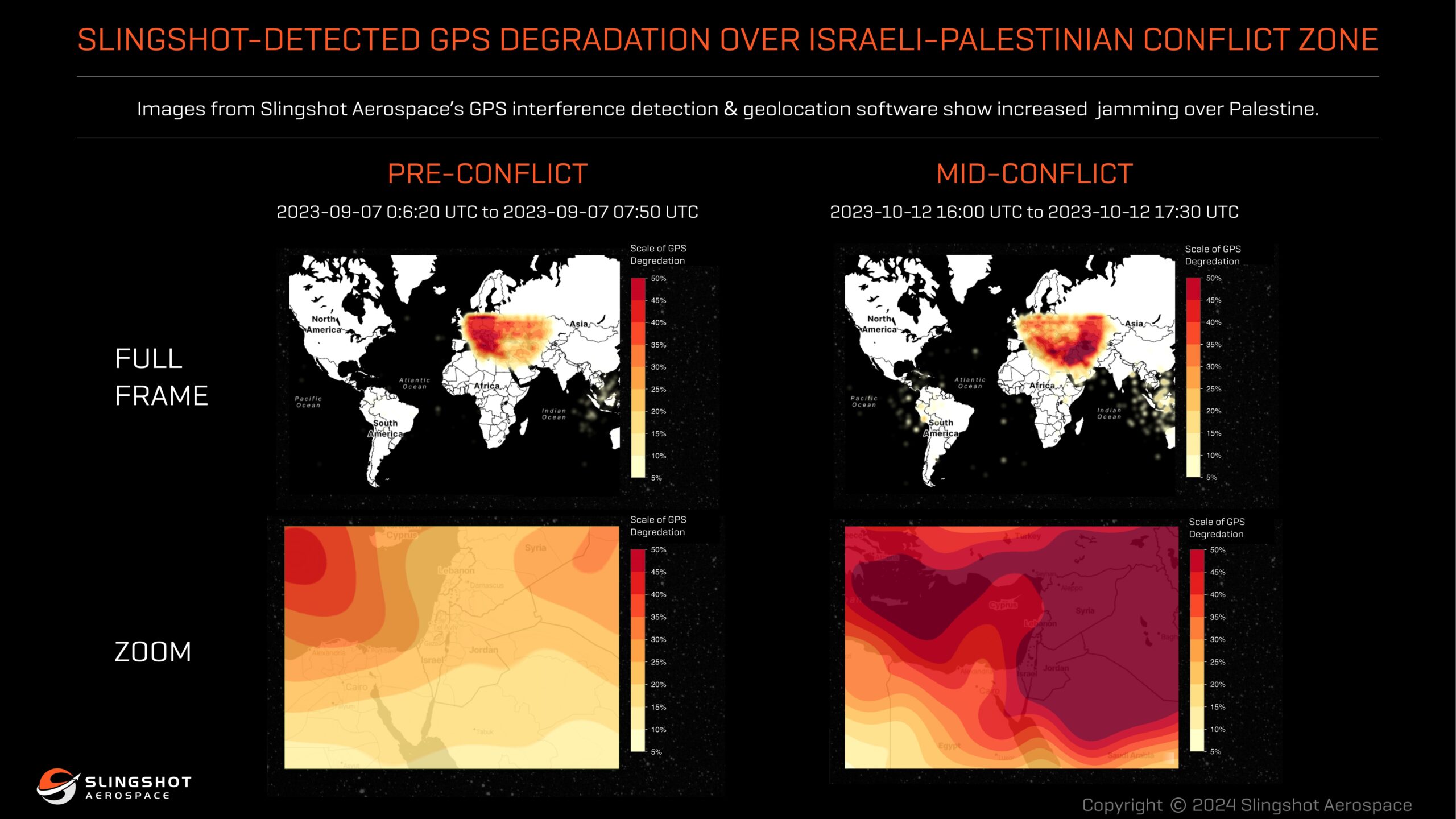
EL SEGUNDO, CA, Jan 17, 2025 – Slingshot Aerospace, Inc. has announced that it has been awarded $1.9 million from the United States Space Force’s (USSF) Space Systems Command (SSC) to develop further Slingshot’s existing GPS jamming and spoofing detection, geolocate the sources and predict patterns of interference. Intentional GPS spoofing–a malicious technique that manipulates GPS data to skew an object’s geolocation–and GPS jamming are used across conflict zones to weaken combatant technology and often warn about future threats to national security.
Source: Slingshot Aerospace
The new program, PNT-SENTINEL (Positioning, Navigation, and Timing – Secure Electronic Navigation Threat Intelligence and Location), provides Slingshot with new funding to enhance its already operational technology by incorporating AI and predictive analytics to more rapidly disseminate insights to warfighters and support faster, more informed decision-making.
The PNT-SENTINEL contract was awarded as a Small Business Innovation Research (SBIR) Phase 2 contract by SpaceWERX, a space-focused division within the innovation arm of the U.S. Air Force, AFWERX. SSC awarded Slingshot a $1.9 million Phase 1 contract to develop its initial GPS jamming detection capability called DEEP (Data Exploitation and Enhanced Processing) in October 2021. The technology produced as a result of the DEEP contract provides the foundation for PNT-SENTINEL and is currently being used by the USSF to detect GPS jamming and ground-based interference sources related to ongoing conflicts, potential future conflict zones, and counterterrorism efforts.
“Modern military operations rely on space systems like GPS, so it’s no surprise that GPS jamming is already a pervasive threat,” said Tim Solms, chief executive officer, Slingshot Aerospace. “In addition to military operations, the larger global community is also highly reliant on GPS, but jamming and spoofing may not discriminate between military and civilian users – meaning that functions of daily life like financial transactions and commercial air traffic control could also be affected.”
Today’s global community relies more than ever on the signals from Global Navigation Satellite Systems (GNSS), which are satellite constellations that provide global PNT services. This includes the U.S. GPS system, the European Galileo system, and more. By interfering with those signals, bad actors can hamper satellite operations over a certain region. This interference also impacts ground- and air-based operations, including crewed aircraft, drones, and precision-guided munitions–and disrupts critical services for everything from troops on the ground to commercial airline operations and passenger vehicle navigation.
As part of the contract, Slingshot will leverage its recently announced AI model called Agatha, that helps identify anomalous spacecraft within large satellite constellations, to further explore, develop, and integrate cutting-edge AI into PNT-SENTINEL. By layering AI into Slingshot’s current technology, it will become more robust and automated in its ability to detect and flag jamming and spoofing threats, as well as differentiate between unintentional or anomalous interference and nefarious acts. Other enhancements to Slingshot’s capabilities include:
Implementing pattern of life algorithms: Advanced patterns of life recognition will identify, flag, and evaluate active jamming events, predicting situation evolution.
Multi-GNSS processing: Slingshot will expand beyond monitoring GPS interference and will detect jamming of multiple global navigation satellite systems by ingesting data from various sources, including allied nations’ spacecraft, for a comprehensive real-time view.
Interoperable with existing warfighter systems: The capability will integrate with existing systems for real-time information dissemination, empowering warfighters to make timely decisions for strategic advantage.
Enhancements to the user interface: An enhanced interface that will allow warfighters across the US and allied services in making informed decisions during security operations.
Slingshot’s GPS jamming and spoofing detection and geolocation capabilities leverage data passively collected by a mesh network of thousands of satellites canvasing the Earth. By collecting degradation signals from thousands of satellites that are constantly canvassing the globe, Slingshot is able to create a near-real-time picture of where GPS jamming is taking place on Earth at any given moment. Space-based technology offers broader jamming insight than existing ground-based detection systems. Legacy ground-based systems tend to have fixed receivers or limited distance receivers, that creates information gaps due to smaller coverage areas and limited deployment options in contested zones on land or at sea.
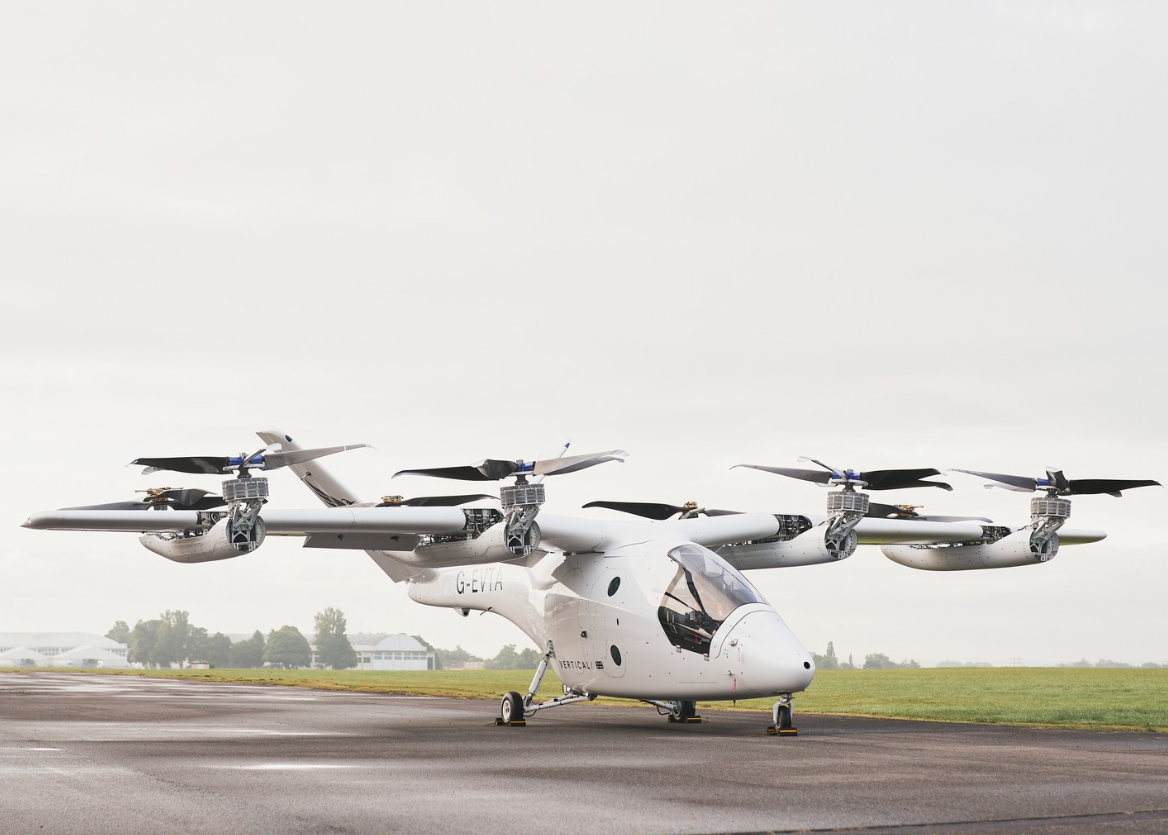
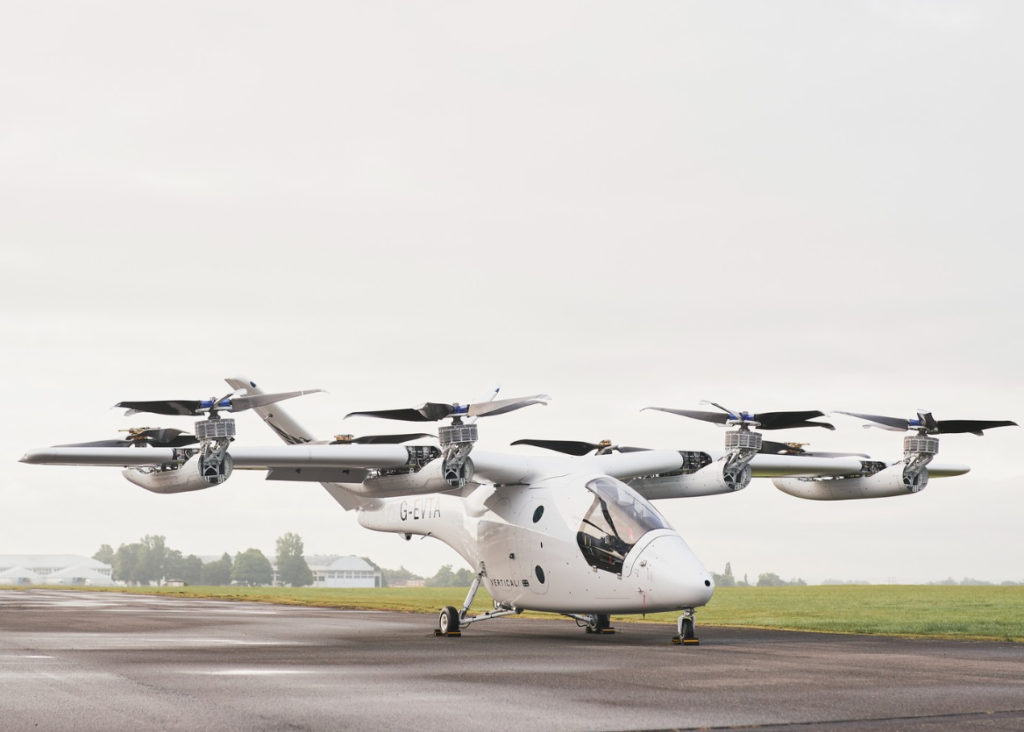
LONDON, UK and NEW YORK, NY, Jan 15, 2025 – Vertical Aerospace has announced the appointment of Dómhnal Slattery as chairman of its Board of Directors with immediate effect. Mr. Slattery brings over three decades of global aviation industry expertise to Vertical and rejoins the Board having previously served as chairman from Jan 2022 to Aug 2023 during which time Vertical built a strong order book and listed on the New York Stock Exchange.
Mr. Slattery is one the world’s leading aircraft leasing and finance pioneers having founded and built Avolon and SMBC Aviation into leading industry players. As of present day, they are respectively ranked as the number two and three aircraft leasing companies in the world. Dómhnal Slattery is also CEO and chairman of Clahane Capital.
Vertical will benefit from Mr. Slattery’s leadership and capital markets expertise and, in particular, his understanding of and track record in the global aviation sector. The businesses he has founded and built have collectively raised and deployed over $75 billion in capital.
Mr. Slattery was the 2023 recipient of the International Society of Transport Aircraft Trading (ISTAT) Award and the “Outstanding Contribution to the Aviation Industry” award at the Aviation Industry Awards in 2016. He was also awarded an honorary doctorate from Dublin City University in 2022 and the NYU Lewis L Glucksman Award for Ethical Leadership in 2020 – both of which recognized his contribution to aviation and entrepreneurship.
The appointment of Mr. Slattery as Chair follows significant progress for the business on its path to commercialize zero emissions air travel. Vertical recently strengthened its balance sheet by $180 million including securing $50 million of new committed funding. Vertical also became the second company in the world to achieve piloted thrustborne flight with a full-scale vectored thrust eVTOL aircraft.
Stephen Welch, the outgoing chairman, will continue to serve on the Vertical Board as a non-executive director.
Dómhnal Slattery, Vertical chairman, said, “Vertical is leading one of the most transformative shifts in aviation history, driving the transition to zero-emissions flight. I am excited to re-join the business at such a pivotal time. We have the team, technology and vision to pioneer electric aviation and deliver on our ambition to be the world’s leading eVTOL company by the end of the decade.”
Stuart Simpson, CEO at Vertical Aerospace, said: “Dómhnal’s remarkable track record of founding and scaling world-class businesses positions him perfectly to guide Vertical’s journey. His leadership, understanding of capital markets and deep industry expertise will be invaluable as we accelerate towards achieving our Flightpath 2030 goal of becoming the global leader in the eVTOL sector.”
NEWPORT NEWS, VA, Jan 9, 2025 – Collier Aerospace Corp. has announced that its design and analysis software was chosen by Swift Engineering, Inc., for structural sizing, analysis and test validation of the low-boom X-59 aircraft’s nose cone. This experimental aircraft from Lockheed Martin Skunk Works is part of the Quesst (Quiet Supersonic Technology) mission of U.S. National Aeronautics and Space Administration (NASA) to quiet loud sonic booms. Swift Engineering was contracted to build and perform structural analysis and certification testing for the X-59’s distinctive, 35 ft.-long nose cone, designed to control aerodynamic pressure waves (shock waves), that form at the sharp nose tip during supersonic flight, resulting in quieter sonic booms.
The X-59, a unique experimental aircraft from Lockheed Martin Skunk Works, is part of the Quesst (Quiet Supersonic Technology) mission of U.S. National Aeronautics and Space Administration (NASA) to quiet loud sonic booms. Photo Credits: Lockheed Martin / NASA
Collier Aerospace’s software enabled Swift Engineering to remove mass that reduced the nose cone’s weight by over 25 percent while maintaining dimensional stability; evaluate the design for a wide range of load cases; and provide detailed stress reporting to support part release and fabrication. The company also used the software to perform detailed analyses, supporting structural testing substantiation of the structural design.
Collier Aerospace’s design and analysis software was chosen by Swift Engineering, Inc., for structural sizing, analysis and test validation of the X-59 aircraft’s nose cone. Photo Credits: Lockheed Martin / NASA.
“The Collier Aerospace software played a critical role throughout this high-visibility project to design, engineer and build the X-59 nose structure,” said Bill Giannetti, technical consultant to Swift Engineering. “At the outset, when the team from Skunk Works explained how important lightweighting was, I had so much confidence in the software that I was convinced we would remove 100 pounds from the nose cone. However, we surpassed that goal by achieving a significant weight savings of over 25 percent on the nose cone structure.”
Giannetti added, “We were able to iterate the structural sizing software with our finite element analysis solver, which enabled weight reduction through structural optimization and rapid load path convergence. Once the system was set up, we could literally watch the mass come out of the nose structure, while meeting all the traditional aerospace failure criteria simultaneously. It’s a fantastic software tool.”
Meeting Rigorous Requirements
To lower the weight of the approximately 400-lb. preliminary design, that specified graphite/epoxy composite and a honeycomb-core sandwich structure, Swift Engineering’s team removed unnecessary plies, simultaneously optimizing the structure for stress and stability. The Collier Aerospace software enabled the team to evaluate design alternatives by considering trade-offs in ply-layup schedules and core panel and edge band thicknesses, and then assess the change to the section stiffness and deflection.
Swift Engineering used the full capabilities of the Collier Aerospace software for this unique aircraft nose structure, extending beyond preliminary sizing and optimization to include conducting detailed laminate strength analysis using design allowables derived from testing. The software enabled the company to deliver the nose cone ahead of schedule and under budget.
HyperX software automates stress analysis and design. It performs rapid structural sizing to all load cases, lightweighting and margin writing. The software helps ensure the producibility of a composite part by creating a design that is optimized for manufacturability. It reduces schedule time by speeding up the engineering cycle and shortening the U.S. Federal Aviation Administration (FAA) and European Union Aviation Safety Agency (EASA) certification processes.
Example of HyperX/HyperSizer Sizing Results for Margins of Safety.
From Boom to “Thump”
The goal of the X-59 aircraft, which is expected to make its first flight in 2025, is to help establish an acceptable noise standard for commercial supersonic flights over land, potentially resulting in U.S. and international regulators lifting a five-decade-long ban that was imposed due to loud sonic booms. Attributing to its unique geometry, particularly the elongated nose cone, the X-59 is expected to generate a barely audible thump rather than a boom, reducing noise impacts.
“We’re grateful that our software helped Swift Engineering achieve success with the X-59 nose cone and met the high expectations of Lockheed Martin Skunk Works,” commented James Ainsworth, vice president, Engineering Services, Collier Aerospace. “The high level of credibility that our solution has earned, and its powerful sizing and analytical capabilities, were key factors in Swift’s decision to choose our software. We’re looking forward to the X-59’s first flight.”
Siemens has a booth at CES 2025. I imagine the attendees, most of them electronic gadget lovers, think Siemens a company on a mission to save the world judging from the exhibits. Indeed, many of Siemens’ exhibits emphasize sustainability. The booth is big by CAD show standards. It has a 2nd floor! However, none of the ground-level displays convey the true Siemens: a global manufacturing conglomerate that makes trains, giant wind turbines, power plants, engineering software, and more.
Perhaps sensing the crowd at CES would have no appetite for their manufacturing prowess; Siemens went forward with what is becoming their secondary initiative: sustainability. Smart. Staffing the booth with young, environmentally conscious employees who took the company’s sustainability-minded customers seriously: even smarter.
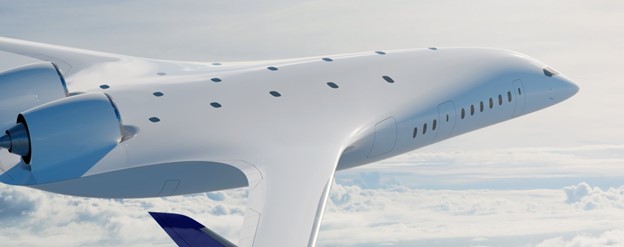
First and most impressive is JetZero, a wide-body blended-wing aircraft meant for commercial flights. It’s not the actual aircraft, mind you, though I would not be surprised if a future CES would roll one onto the parking lot of the Las Vegas Convention Center, the main venue of CES. This year’s show has only smaller aircraft.
JetZero’s goal is to eventually run on green hydrogen. The company’s name is derived from Net Zero and the current design is halfway to Net Zero. The blended wing design accommodates a cabin wider than the widest body flying these days. The cabin has more room and, depending on cabin configurations, should supply more comfort for passengers. The double-deck cabin avoids the tunnel-like interior of aircraft, resembling more the interior of a small ship.
How will JetZero manage to build an aircraft without a tubular fuselage that can withstand the pressure difference at altitude? We don’t know at this point.
JetZero uses NX, Siemens’ enterprise CAD software. They were using Sony’s new headset to walk around virtually inside the aircraft model.
Spinnova creates clothes with 97% less water and with74% reduction of carbon emissions compared to other clothing manufacturers. This is due to a “machine-based,” rather than a “water-based” process. A cotton shirt, for example, gets cotton from a plant that takes water to grow and be productive. It takes almost no water to shred the worn-out shirt and make another shirt. The name Spinnova may be derived from either “spin innovation” or “spin over.” Either way: genius.
A scale model of Siemensstadt, or Siemens City, is the company’s new headquarters. The main building, Siemensstadt Square, has been awarded platinum status for being carbon neutral by the German Sustainable Building Council, DGNB.
The Wayout water treatment plant is contained in a standard 20 ft container so it can be transported easily. Once installed on site, it can produce enough clean water for 3,00 people, according to the company website. It gets all its power from the sun. All a water treatment company (water treatment companies are Wayout’s target customers) has to do is set it up near polluted water, and the Wayout plant goes to work. It can treat anything from gray water (such as from sinks and washing machines) to saltwater to sewage. How exactly it manages this, whether micro sieves, reverse osmosis, distillation or a combination, is yet to be explained.
Desertification, the process by which fertile soil becomes unproductive sand, happens naturally but has accelerated due to global warming. Large parts of Africa are becoming part of the Sahara Desert, for example, and creating humanitarian crises. The soil, devoid of organic material, turns into sand and is unable to retain the water from the little rain that falls so nothing grows. Desert Control has a solution. By mixing its proprietary Liquid Natural Clay with the sand, the ground is once again able to retain the water long enough for plants to grow. LNC is natural minerals electrically charged particles of natural minerals.
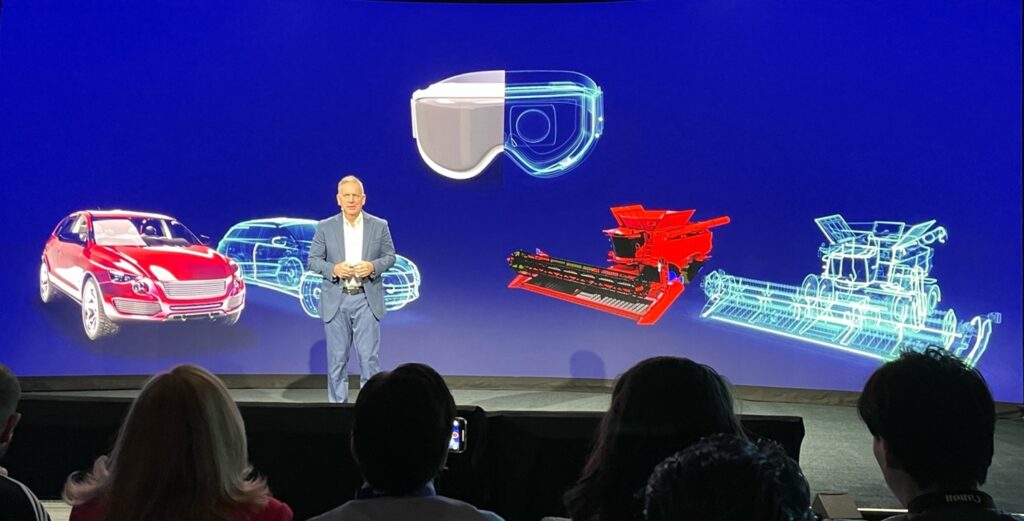
Siemens held a press conference at Mandalay Bay and has constructed a mini-Siemens City at the Las Vegas Convention Center, where CES 2024 is mostly held. (It seems the vast event covers the entire Strip.) This year, CTO and Paul-Newman lookalike Peter Koerte opened to applause. I must say CES draws an extremely well-behaved and polite audience. The crowd at CAD events tends to have more of a “show me” attitude. Koerte does not disappoint. He is polished, poised and relatable. I had to wonder if he was a real CTO. Actually, he is more than a CTO. He is also a member of Siemens’ board of directors and their chief strategy officer.
Siemens, in keeping with all others at CES and the last year of conferences, led with a discussion of AI. Their spin on AI, however, was that Siemens alone had industrial AI.
Large language models like ChatGPT learn on text data, and they are, surprisingly enough, running out of data, says Koerte. Meanwhile, industry has a never-ending supply of data. So much data is streaming from sensors from manufacturing operations, IoT devices, monitoring equipment and the like.
Now, imagine being able to combine natural language prompts with industrial AI to diagnose problems. “Why is this robot missing every 5th weld?” for example.
Koerte explained what Siemens, a global manufacturer, was doing at CES, a show normally associated with the gadgets. Siemens was basically the wizard behind the curtain, Koerte explained. All of the CES 2025 keynote companies are either designed with Siemens software or are partners of Siemens. All the auto manufacturers, many of whom were displaying their latest technology at CES, use Siemens products. So did many of the consumer product companies, some of whom have a bigger footprint at the show, such as Sony, LG and Samsung.
Koerte made additional announcements. (See full announcement.)
1. JetZero will be using Siemens applications. The innovative blended-wing commercial jet is sure to get Siemens some attention. JetZero’s CEO, Tom O’Leary joined Koerte on stage to thank Siemens for creating a platform that will help JetZero be the first all-digital aircraft. While Boeing 777 was the first aircraft to be designed completely with CAD (CATIA), JetZero’s aircraft will be designed, manufactured and maintained using the Siemens Xcelerator platform.
JetZero’s name suggests Net Zero and the aircraft gets halfway there, reducing carbon emissions by 50%.
2. Siemens for Startups. Siemens will offer 90% discounts on software to startups in their first year, 80% in the second year and 70% in the third year.
3. The Sony XR head-mounted display. Apple may have lost interest in XR, stopping production on its XR, headset but Siemens thinks an XR headset, if made right, would be great for immersive viewing. “Your used to have to do this with CAVEs,” says Tony Hemmelgarn, president and CEO of Siemens Digital Industries.
4. NVIDIA collaboration. The Teamcenter Digital Reality Viewer will be powered by NVIDIA’s Omniverse technology.
5. Designcenter. Hemmelgarn joined Koerte onstage to announce the Designcenter suite, which will include Solid Edge and NX. Both will use one data file format. Could this be the happy ending to the Solid Edge story, with the parent Siemens finally adopting Solid Edge, which it once kept under the stairs, and telling its favorite child, NX, to play nice?
Siemens, by being a big presence at CES, while its competitors in design software, stayed home, is establishing itself as a technology leader. Jensen Huang, CEO of NVIDIA and today’s tech darling said Siemens had become the operating system of the industry.
LAS VEGAS, NV and MUNICH, Germany, Jan 7, 2025 – Siemens has presented its vision for the future where data, AI and software-defined automation will converge to enable unprecedented flexibility, optimization and continuous improvement across the world’s industries, for companies of any size. This ambition is at the heart of Siemens’ presence at CES 2025, the world’s most influential tech event. Siemens – the global leader in industrial software –demonstrated how its technologies are empowering customers to take bold leaps in industrial innovation.
Peter Koerte, Member of the Managing Board, chief technology officer and chief strategy officer, Siemens AG at CES 2025, Las Vegas.
“Industrial AI is a game-changer that will create significant positive impact in the real world across all industries. Industrial AI allows us to harness the vast amounts of data generated in industrial environments and turn it into insights that drive real business impact. We are adding new industrial AI capabilities across the Siemens Xcelerator portfolio to enable our customers to stay competitive, resilient and sustainable in an increasingly complex world,” said Peter Koerte, Member of the managing board, chief technology officer and chief strategy officer, Siemens AG.
Siemens is bringing Industrial AI directly to the shop floor with the new Siemens Industrial Copilot for operations, enabling AI tasks to run as close as possible to machines. This facilitates rapid, real-time decision making for shop floor operators and maintenance engineers, boosting productivity, operational efficiency and minimizing downtime. The Siemens Industrial Copilot ecosystem is continuously evolving to offer AI capabilities across the industrial value chain and into sectors including discrete and process manufacturing, infrastructure, and mobility. This suite of copilots can enhance human-machine collaboration across all experience levels, helping to accelerate development times and innovation cycles. The Siemens Industrial Copilot will be integrated with the Industrial Edge ecosystem, which has been enhanced with AI for deploying, operating and managing AI models within the production environment.
JetZero Selects Siemens Xcelerator Platform
During Siemens’ press conference at CES 2025, the company announced an agreement with JetZero, a pioneering aviation startup working to build the future of sustainable air travel, to collaborate on the development and production of JetZero’s revolutionary blended wing aircraft. The innovative blended wing design aims to improve fuel efficiency by 50 percent, reduce noise and deliver the promise of zero carbon emissions by 2035. JetZero will leverage the Siemens Xcelerator open digital business platform to design, manufacture and operate their new aircraft.
Blended wing aircraft by JetZero
JetZero is planning to build “Factory of the Future”, a new greenfield factory in the United States where they intend to tightly integrate Siemens’ automation hardware, software and services to help it achieve its remarkably ambitious vision encompassing electrification, automation and digitalization of both the aircraft and its production. The JetZero aircraft and its associated manufacturing operations will be simulated virtually using comprehensive digital twins – enabling the company to de-risk the manufacturing process, validate the approach and scale processes long before any ground is broken or jets take to the skies.
“Siemens is giving us the confidence to take a leap, not just a step, in revolutionizing air travel,” said JetZero CEO Tom O’Leary. “Their digital twin and industrial metaverse technologies will be instrumental in helping us design, build and operate the world’s first fully digital aircraft, delivering a better experience for passengers and airlines while also reducing fuel consumption by 50 percent.”
Siemens democratizes industrial tech for startups
Siemens’ presence at CES also highlighted the company’s commitment to enabling startups and companies of all sizes to use its industrial metaverse technologies. Through the new Siemens for Startups program, innovators of any size have access to the intelligence, ecosystems and technologies they need to turn their big ideas into world-changing innovations. Siemens is providing access to venture partnering and clienting services along with dramatically reduced cost access to software and hardware from the Siemens Xcelerator open business platform. In addition, Siemens is collaborating with Amazon Web Services to offer AWS credits, business development resources and access to the AWS Activate program for technical and go-to-market support.
Collaborating with NVIDIA to bring photorealism to PLM
Together with NVIDIA, Siemens announced new additions to the Siemens Xcelerator open digital business platform, including the Teamcenter Digital Reality Viewer powered by NVIDIA Omniverse, which brings large-scale, physically based visualization directly into the product lifecycle management (PLM) system. This capability also enables teams to collaborate in a secure, digital twin environment using their live 3D data, reducing errors and data discrepancies while streamlining workflows and decision-making.
“Our continued collaboration with NVIDIA will be transformative for our customers, empowering them to virtualize and visualize product and plants like never before. Bringing together the best-in-class capabilities of each company, we’re equipping customers with the tools they need to make informed decisions, optimize their operations and accelerate their digital transformation,” said Koerte.
Enabling immersive engineering with Sony
In collaboration with the Sony Corp., Siemens is delivering a new solution for immersive engineering that brings together Siemens NX software for product engineering with a breakthrough head-mounted display from Sony to enable content creation for the industrial metaverse. Now available for pre-order and shipping beginning in February, Siemens’ new Immersive Engineering toolset brings the power of mixed reality to the product engineering and manufacturing community, enabling high-fidelity mixed reality and 3D-focused collaboration.
“In the era of digital twins, Siemens and Sony have collaborated closely to bring NX Immersive Designer to market. With 4K OLED Microdisplays, intuitive controls and the comfortable design, closely integrated with Siemens’ advanced software, we firmly believe this new immersive engineering solution will pave the way for the future of engineering.” said Seiya Amatatsu, Incubation Center, XR Technology Development Division, Sony Corp.
Introducing Designcenter for product engineering
Koerte was joined on stage at CES by Tony Hemmelgarn, president and CEO, Siemens Digital Industries Software, to unveil Siemens’ new Designcenter software suite, which brings together its portfolio of design and engineering software including Solid Edge and NX software in one unified offering so that companies of any size can design and collaborate using the industry-leading Parasolid modeling kernel.
“A lot of companies make their design software available to small businesses or to the very largest enterprises. Designcenter is unique in that it is truly open and accessible for everyone – companies of every size can scale with the same solution set, their data in the same format – without interruption,” said Hemmelgarn.
Technology to transform the everyday
At the Siemens booth in the North Hall of the Las Vegas Convention Center, Siemens is showcasing how its technology transforms the everyday, for everyone, through examples of solutions created by Siemens and its customers that impact personal, local and global communities. In addition to JetZero , these examples include:
Spinnova is a Finnish technology company that enables circularity in textile manufacturing with sustainable and chemical-free fabric production using Siemens’ Digital Twin technologies and factory automation.
Wayout International , a Swedish water technology company developing a proprietary drinking water production solution to improve personal health and well-being in daily life using Siemens’ edge computing, digital twin technologies and Insights Hub, the industrial IoT as a service solution from Siemens.
Desert Control is a Norwegian startup aiming to revolutionize sustainable agriculture and urban greening in regions suffering from desertification, fostering agricultural prosperity and healthy green space using Siemens’ Industrial Operations X.
Arc is an American company focused on the electrification of the marine industry and making boating more modern, enjoyable, and sustainable using Siemens’ NX, Teamcenter and Simcenter STAR-CCM+ software.