Muan may be the worst place in South Korea for an airport. The south of South Korea , with its many islands, is a haven for seabirds. It has the highest incidence of bird strikes in South Korea. So, it was perhaps no big surprise to the pilot of Jeju Air flight 2216, a veteran with over 6800 flight hours, to be warned of bird strikes at 8:57 AM local time on a sunny Sunday, December 29, 2024 by Muan International’s air traffic control.
Fair warning, indeed. With the air thick with birds, one or more may have been ingested by one of the engines on the Boeing 737-800. The pilot issued a mayday alert. A local news video captured flames briefly erupting from an engine. The pilot attempts to land, but the landing gear is not descending, and he is forced to go around and try again. A few minutes later, still without landing gear down, the pilot does a belly landing. The speed is visually estimated to be “about 200 miles per hour,” higher than the 120 to 150 mph normal for a 737-800. The aircraft makes contact with the ground less than halfway down the 2,800 m (9,186 ft) runway, giving it precious little distance to slow down. A 737-800 requires a minimum of 1,830 m to stop with landing gear and brakes. Coming in hot, sliding on its belly with no brakes, no thrust reversers and with flaps level, the aircraft overshoots the runway, covers 140 meters of open ground and slams into an earth and concrete structure. It explodes in a ball of flame. Of the 175 passengers and 6 crew, only two flight attendants buckled into their jump seats at the back of the aircraft and survived, though both were seriously injured.
Muan International Airport is a regional airport 170 miles south of Incheon International airport in Seoul, South Korea.
The investigation has begun. We won’t know what caused the landing gear not to be deployed and if and how the landing gear failure and the bird strike were related. It will be months before an official report is available.
However, to David Learmont, a former RAF pilot and aviation journalist interviewed by Sky News, the cause is clear. He puts the blame completely on the berm, a concrete/earthen structure off the end of the runway, calling its placement “criminal.”
The berm holds the localizer for the ILS (instrument landing system), part of the aircraft sensing system that airports use, but instead of being so massive, it should have been in a more forgiving structure, says Learmont.
The pilot had been heroic, says Learmont. He executed a perfect landing under the most demanding of situations. He reviews Google Maps and visually estimates enough “level ground” after the runway to have slowed the aircraft a great deal, if not stopped it altogether, and “more people would have survived.”
The localizer, vital for bad weather and low visibility landings, are typically installed at ground level or on a “collapsible” structure, says Learmont.
From the aerial view, it may appear that the berm serves as protection for the traffic on the road encircling the airport and the highway further down, but its true purpose is to elevate the localizer.
The Consumer Electronics Show, CES, if not a physical realization of science fiction, may be a portal into the future. Where else would you hear of a land-based aircraft carrier?
Even with the blizzard of press releases from companies exhibiting at CES 2025, Expeng AeroHT flies out. Flying cars may be passé for CES veterans (the company displayed its first flying car at CES 2024), but even the most jaded tech journalist will have to admit that a two-seat chopper stored in the back of a 6-wheel Cybertruck-looking vehicle is a first.
In a video, we see the Land Aircraft Carrier in CG. It automatically unloads the six-rotor aircraft, which unfurls its rotor blades and takes off with a pilot and a passenger.
Pilots of fixed-wing aircraft will make fools of themselves trying to fly helicopters, but Expeng AeroHT says that an ordinary person can learn to fly their chopper in 5 minutes and master it in 3 hours.
The company will be previewing it to the media at the Las Vegas Convention Center at CES 2025. As it is indoors, I expect we won’t see it fly.
One might dismiss the “land carrier” as outlandish, unlikely to pass aircraft regulations in the US and the EU and relegated to airspace over countries where dollar-billionaires flaunt their wealth over millions less fortunate. Still, we can no longer dismiss China’s commitment to EVs and with Xpeng AeroHT, to the new air mobility. The company had its first flying car prototype in 2016 and has since managed to get what looks like a full-size car off the ground. It has rolled out a super-futuristic eVTOL (electric vertical takeoff and landing) aircraft that keeps its blades tucked under its back (like a ladybug but sleeker), converting Transformer style into a quadcopter. That’s radical. To have cameras instead of side view mirrors and a pillar-to-pillar LED display is to be expected.
Xpeng AeroHT will be taking advanced orders by year-end and promises to ship by the end of next year. Cost: 2 million yuan ($280,000).
Would you fly in an airplane that AI created? As an engineer in awe of what fellow engineers have done to get an aircraft in the air and back down safely, my gut reaction is: definitely not. But after a momentary reflection of Boeing’s safety issues (Why Boeing’s Top Airplanes Keep Falling, New York Times, Feb 12,2024 and Downfall: The Case Against Boeing, Netflix, 2022, just two of many worrisome reports), I am willing to give AI a try.
Enter PhysicsX, a UK-based startup that promises a “quantum leap” with its software that blends AI with shape optimization.
PhysicsX showcases its technology in AI.airplane, a free online app that lets you design aircraft. You may not be able to design an aircraft down to its rivets nor create an aircraft of any commercial or military value, but you can have a lot of fun pretending to do real simulations on unreal aircraft.
AI.airplane will evaluate the overall shape for its lift, drag, stability and stresses, though that be the gross exterior shape only.
Granted the shapes are rudimentary, even playful – not the stuff of serious commercial or military aircraft. Nor is that PhysicsX’ intent. To use AI.airplane, you must sign off on the terms of service which state “Output may not always be accurate. Our Services are provided for technology demonstration and You should not rely on Output from our Services as a reliable source to create real outputs.“
In other words, don’t try this at work. It’s intended for hobbyists, for toys. Maybe you could use it for conceptual design. But it is not to be used for accurate, detail design of any type.
That being said, what a lot of fun AI.airplane can be.
Enter the weight of the aircraft and AI. airplane presents 20 possible shapes, each a deformable mesh that behaves like a sub-D model. You can deform it by pushing and pulling on deformable points. In a twinkling, you get what appear to be realistic pressure gradients (highest at nose and where wings meet the fuselage). Stresses are also highest where you would expect them to be.
How is PhysicsX’ so fast? AI.airplane’s speed and seeming accuracy are indeed remarkable. It is most certainly not painting colors for effect, a common marketing trick.
PhysicsX is, in effect, cheating. To put it more mildly, it is making an educated guess.
AI.airplane is a technology demonstrator, a publicly available app based on LGM-Aero. LGM stands for large geometry model, which is to shapes what large language models (LLMs, like ChatGPT) are for language.
LGM-Aero is trained on 25 million meshes and “tens of thousands” CFD and FEA simulations generously supplied by Siemens’ Simcenter, according to the company’s announcements. This is what is known in the AI world as unsupervised machine learning. In theory, if done well and if the shapes and conditions are similar from one to the next, the AI-based application can forego the millions of calculations FEA and CFD require and make an educated guess as to the result.
Having gone public with aircraft design has created tremendous buzz for PhysicsX. It may just be the shape of things to come. PhysicsX plan is to apply itself to more than just aerospace. It has already been used in automotive and has its sights on chip design, renewable energy and material research.
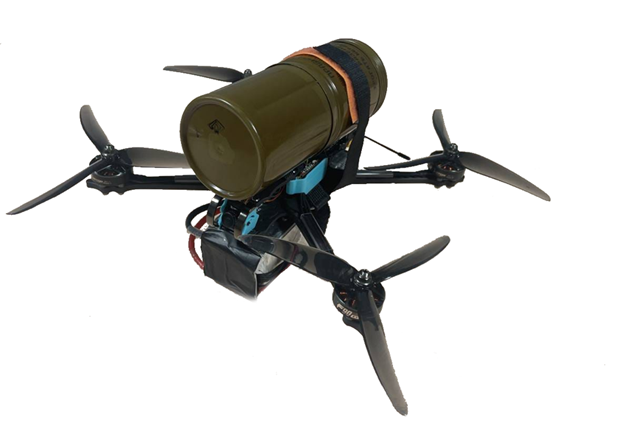
Bombs away. Low-cost drones cost only a few hundred dollars but can take out military targets more effectively than artillery and more destructively than a sniper’s bullet. Image: OneWay Aerospace
The Russian bear that was to have run over Ukraine has been stopped by a swarm of bees. Such are the aerial drones, produced by the tens of thousands every week, according to the Wall Street Journal. Ukraine may not be able to kill the bear with drones but has been able to hold it at bay. We read about Russian soldiers afraid to venture out of bunkers, fleeing at the first sound of a drone. In one video shown to the reporter, two soldiers jump into an outhouse to escape, but a drone no bigger than a dinner plate flies through an impossible opening and blows them to bits. Russian soldiers are pleading for their lives as drones swoop down on them. In one particularly harrowing video, a soldier with legs made useless by grenades dropped from drones, in a field set on fire by drones, put a rifle barrel in his mouth and blows his brains out.
Drone pilots create fear as do the deadliest of snipers. One drone operator in Clear Eyes, a drone group operating in Ukraine, counts over 300 kills. Others have more. By comparison, Chris Kyle, the American Navy SEAL played by Bradley Cooper in American Sniper, had 160 confirmed kills.
Drone warfare, as is conducted by Ukraine, is more ingenuity and resourcefulness than high tech. Ukrainians have adapted consumer drones and improvised to make them into weapons. A small drone can carry as much as 9 lbs of explosives. We read about Soviet-era artillery shells dismantled, their explosive material melted in slow cookers and poured into plastic shells so they could piggyback on quadcopters.
Drone operators are a far cry from the swaggering fighter pilots shown in Hollywood movies like Top Gun or super macho test pilots in The Right Stuff. With their nimble thumbs and race-car fast reflexes, they fit more into the gamer genre. With their POV (point of view) headsets, they can be seen propelling their acrobatic aircraft through courses in arenas such as the FAI World Drone Racing championships, the Super Bowl of drone games, reaching speeds of up to 90 mph.
The fun and games of drones turn into not just life and death but intergalactic war science fiction in Ender’s Game, where a teenage game whiz is tricked into joining the planet’s military, all the time thinking he was only playing a video game.
Back to the Real Battlefield
Ukraine uses civilians as drone operators and embeds them with regular military units. While one drone operator expresses guilt for killing humans as if playing a game, most are more than up to the task, intoxicated at the idea of killing Russians in defense of their country.
The drones have a range of 12 miles, longer and more accurate than artillery shells. They cost about $500. Their Achilles heel is they have to be guided towards the target. The Russians are getting better at jamming the signal. It’s a cat-and-mouse game. Then they are overwhelmed by the sheer numbers of drones.
Still, the bear does not retreat. The makeshift nature of drone manufacturing, the malfunctioning, the limits of battery life, all that which cause many drones to simply crash harmlessly to Earth, with only a third of aerial drones hitting their targets, is good news for the bear.
NASA SpaceX Crew-8 mission astronauts returned astronauts to Earth after an extraordinarily long seven-month expedition on the International Space Station (ISS). They was to be up there for 6 months. Some astronauts remain on the ISS, including Sunita (Suni) Williams, who has already been in space for well over a year (466 days on the day of this writing). Her return trip is scheduled for February 2025.
Their return was delayed primarily due to issues with Boeing’s Starliner spacecraft. In all fairness, the weather may have played some part, but this is a site about technology, not weather.
Problems with Starliner’s failure to launch caused NASA to lose faith in Boeing and the U.S. space agency called on SpaceX for a lifeboat, adding to Boeing’s mounting and continuing woes (more on that later).
SpaceX to the Rescue
The ISS from the SpaceX Crew Dragon, the spacecraft called upon to bring the astronauts home after NASA lost faith in Boeing’s Starliner.
Boeing’s Starliner, originally picked to support crew transportation as an alternative to SpaceX’s Crew Dragon Endeavor, encountered multiple issues, including thruster malfunctions and delays in uncrewed and crewed test flights. After these setbacks, NASA has designated Crew Dragon Endeavour as the primary return vehicle for the ISS.
Crew Dragon Endeavour was able to bring the astronauts back to Earth safely, with a splashdown near Pensacola, Florida. It was yet another success for SpaceX.Saved by SpaceX were all of the NASA SpaceX Crew-8 mission listed below.
Waiting for the astronauts to emerge from the capsule was a nail-biter. But eventually, one after another was carried out on a stretcher. Perfectly normal after so long in space, say the NASA commentators.
Breaking: One of the astronauts returning last Friday has been hospitalized. Their name and condition are not known at the time of this writing.
NASA’s SpaceX Crew-8 makes a safe splashdown, shown in the infrared image. Image from NASA video.
Ready to kiss the deck of the rescue ship were:
Matthew Dominick (NASA), a mission specialist focused on supporting scientific experiments and overseeing technical operations aboard the ISS.
Michael Barratt (NASA), a veteran astronaut and physician, Barratt contributed his expertise in medical and life sciences research conducted in microgravity.
Jeanette Epps (NASA) – Known for her background in aerospace engineering, Epps played a key role in implementing ISS National Lab experiments and technology tests.
Alexander Grebenkin (Roscosmos) – Representing Russia’s space agency, Grebenkin assisted with international collaboration efforts and conducted research on behalf of Roscosmos.
The Mission
The mission was to conduct diverse research aimed at advancing science and technology in low Earth orbit (LEO). During their time on the ISS, the crew supported a wide range of experiments funded by the ISS National Laboratory, with applications spanning medical research, biotechnology, and agricultural science.
The crew worked on groundbreaking studies in in-space production and biomanufacturing, including a project by Cedars-Sinai to develop methods for growing stem cells in microgravity. The goal is to eventually enable large-scale biomanufacturing for treatments addressing heart disease, neurodegenerative conditions, and other diseases.
Another study, led by Redwire and Eli Lilly, explored the crystallization of organic molecules in space, which could lead to more effective pharmaceuticals.
Cancer Detection Technology: Another significant project involved the University of Notre Dame‘s development of ultra-sensitive biosensors capable of detecting early cancer biomarkers. The biosensors were tested in microgravity to refine their sensitivity, potentially improving early cancer diagnostics.
The mission also tested Sphere Entertainment’s Big Sky camera for high-resolution imaging in microgravity and conducted agricultural research on the growth of Arabidopsis plants in varied orbital altitudes to inform crop production strategies for space missions.
Losing Interest
NASA no longer sends its rockets to the International Space Station. The U.S. government agency, once the pride of the American engineering community, has shifted towards partnerships with private enterprises.
It started in 2011 when NASA retired the Space Shuttle program, the primary means of ferrying astronauts and cargo to the ISS. To maintain access to the station, NASA established the Commercial Crew Program (CCP), contracting private companies like SpaceX and Boeing to develop and operate rockets for ISS missions. This partnership was ostensibly to enable NASA to focus its resources on deep space exploration while relying on private enterprise for low-Earth orbit missions.
However, abandoning the ISS and LOE in general is more due to NASA’s budget, which has withered to just 0.5% of the national budget, a far cry from the 4.5% of its heyday. Granted, NASA’s budget may have grown with recent appropriations, reaching $25 billion, but its percentage of the total U.S. budget is still much smaller than in the 1960s with the Apollo program. That was NASA at its proudest. It may have been driven in large part by Cold War pressures and the race to land a man on the Moon, but it marks the pinnacle of engineering. However, with the race to the Moon over and the Cold War won, public interest in space exploration decreased. NASA’s budget decreased, stabilizing at around 1% by the 1970s and dropping further over subsequent decades.
NASA claims contracting private companies has saved billions of dollars. But at what cost for NASA in terms of image?
Boeing in a Tailspin
The Starliner spacecraft, part of Boeing’s initiative to support crew transportation as an alternative to SpaceX’s Crew Dragon, encountered multiple issues, including thruster malfunctions and delays in uncrewed and crewed test flights. These setbacks meant that Starliner was unavailable to bring the Crew-8 astronauts home, leaving SpaceX’s Crew Dragon Endeavour as the primary return vehicle. Additionally, poor weather conditions around splashdown zones in Florida further postponed the Crew-8 return, with hurricanes and storms in the area making safe reentry challenging.
Ultimately, Crew Dragon Endeavour brought the astronauts back to Earth safely, with a splashdown near Pensacola, Florida. This marked yet another successful recovery for SpaceX, underscoring its reliability amid challenges with the Starliner program.
SpaceX was quick to take advantage. While SpaceX was initially conceived to go to Mars, the company seized on the opportunities in low Earth orbit. Its Starlink satellite system is the biggest in the world. NASA is the biggest private company’s customer.
Boeing has experienced several notable setbacks in recent years:
737 MAX Crisis (2018-2020): Boeing’s 737 MAX aircraft were grounded worldwide after two fatal crashes attributed to issues with the Maneuvering Characteristics Augmentation System (MCAS), resulting in 346 deaths. This crisis led to lawsuits, regulatory investigations, and significant financial losses for Boeing.
787 Dreamliner Production Halt (2021): Production of the Boeing 787 Dreamliner was temporarily halted due to quality control issues, including problems with the aircraft’s fuselage. This interruption impacted delivery schedules and Boeing’s financial outlook, adding to the company’s list of costly challenges.
A machinist strike, which halted production on some of Boeing’s best-selling aircraft, is one of the most pressing issues, reportedly costing the company close to $1 billion monthly. With its reputation impacted by delays and a history of safety concerns, Boeing’s financial outlook remains cautious, and credit rating agencies have hinted at potential downgrades, which could increase future borrowing costs. The company’s recent measures reflect its attempt to stabilize financially while addressing production and labor challenges that have impacted delivery schedules and operational plans this year.
Recently, Boeing has faced significant financial and operational challenges, leading it to secure a substantial $10 billion emergency credit line from a consortium of major U.S. banks. This funding was due to the factors listed above and delays with key projects like the 777X airliner. Additionally, Boeing indicated it may need to raise as much as $25 billion through stock or debt offerings to maintain liquidity as it tackles these setbacks.
The International Space Station
The ISS National Laboratory is a unique public research facility aboard the International Space Station that offers scientists and organizations a chance to conduct experiments and develop technologies that aren’t possible on Earth. By harnessing the microgravity environment, the lab supports research aimed at enhancing life on Earth, cultivating viable business models for space-based industries, and building science skills in upcoming generations. Managed by the nonprofit Center for the Advancement of Science in Space (CASIS) under a NASA agreement, the ISS National Lab is open to U.S. government agencies, universities, and private companies for projects across fields like life sciences, materials, and technology. Through this platform, the lab fosters a sustainable, expanding market in low Earth orbit and opens new possibilities for innovation from space to Earth.
The view from the International Space Station using the Sen observations system of Hurricane Milton as it is over Florida. Image from Sen video.
Airbus U.S. has enhanced Earth observation capabilities on the ISS through its ArgUS platform on the Bartolomeo module, allowing smaller payloads to be hosted alongside payloads for larger experiments. ArgUS, supported by the ISS National Laboratory, enables multiple research projects to operate simultaneously, with standard slots starting at 3U in size. Notable payloads include Sen’s SpaceTV-1, a 4K camera system offering real-time views of Earth, freely available through the Sen app, and BAE Systems’ advanced equipment for climate and weather monitoring. BAE’s contributions include a radio frequency receiver for atmospheric analysis and an infrared camera for environmental imaging.
Image: Airbus U.S.
The platform’s newArgUS Multi-Payload Adapter allows for smaller slots, down to 3U size (300 x 100 x 100 mm3)
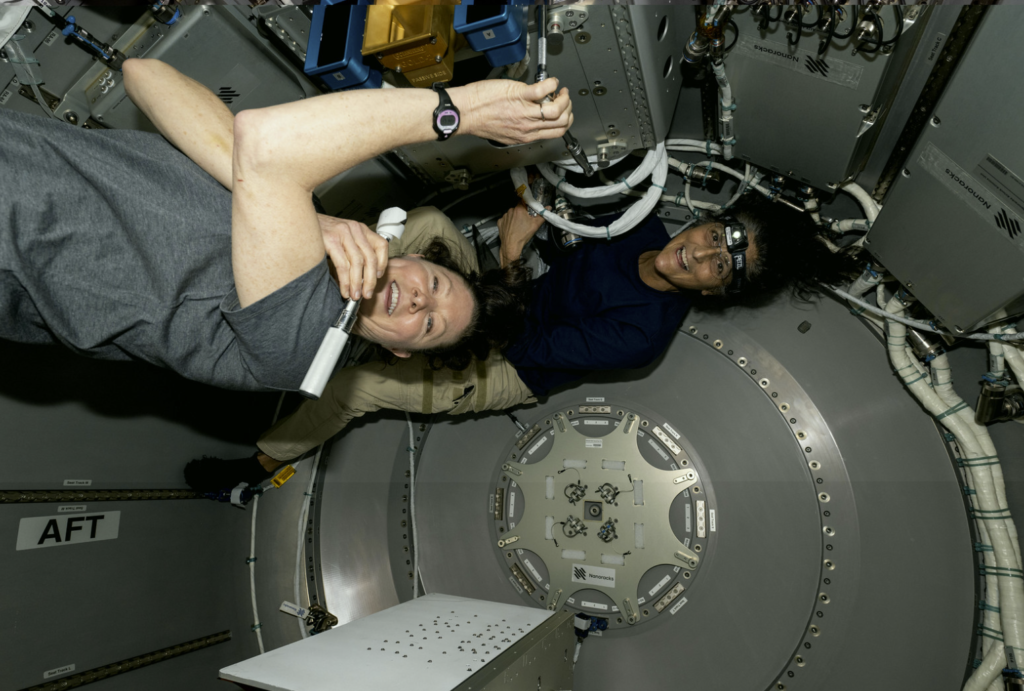
NASA astronauts Tracy C. Dyson and Suni Williams work inside the Nanoracks Bishop Airlock on the ISS, installing the ArgUS Mission-1 hardware to test its external operations in space. Image credit: NASA
These technologies aim to provide new insights into climate change, natural disasters, and other environmental phenomena while potentially supporting future lunar missions. The ArgUS platform is designed to democratize access to space, offering faster data transfer, technical support, and reduced costs for research institutions and private organizations. Launched on SpaceX’s 30th Commercial Resupply Services mission, this setup aims to accelerate scientific research by making crucial data available quickly and affordably. Through ArgUS, Airbus seeks to lower the barriers to space research, offering a practical and collaborative environment for technology demonstrations and scientific discovery.
The Sen cameras on the ISS, specifically the SpaceTV-1 system, work by capturing real-time 4K video from the station’s external vantage point. The system includes multiple cameras: some focus on Earth, providing views of the horizon and downward perspectives, while others monitor activities around the ISS, such as the forward-facing Harmony docking port. The captured high-resolution video streams directly to Earth and is made freely accessible through the Sen app, allowing users to view real-time footage of Earth from space, supporting educational, research, and environmental monitoring purposes.
Sen is a space technology startup founded in 2011 by Charles Black and based in Guildford, U.K. The company focuses on streaming real-time videos from space using its network of satellites. Its goal is to provide high-definition video data from Earth’s orbit for anyone and everyone, not just for space agencies and the military. The company has raised about $8.54 million in total funding, with its most recent seed round in 2022 backed by investors like Mercia Asset Management and Hemisphere Ventures.
Sen is currently being tested on the International Space Station (ISS), occupying a single slot on the in Bartolomeo,
What is Bartolomeo?
Bartolomeo, developed by Airbus U.S., is a versatile payload hosting platform attached to the International Space Station’s Columbus module. It offers easy, cost-effective access to low-Earth orbit for research and commercial projects. Bartolomeo accommodates a range of payload sizes and provides end-to-end services, including launch, installation, data transfer, and optional payload return. It is ideal for Earth observation, material science, robotics, and more, offering an unobstructed view of both Earth and space. This setup enables institutions and private organizations to carry out space missions without needing complex space systems.
The Bartolomeo system, developed by Airbus, got its name from the historical figure Bartolomeo Dias, a Portuguese explorer. Dias is known for being the first European to navigate around the southern tip of Africa, opening the way for a sea route from Europe to Asia in 1488.
“Airbus is improving our ability to observe and understand our planet as well as democratizing access to space by accommodating more research and technology demonstrations on the ISS than ever before,” said Debra Facktor, head of U.S. Space Systems for Airbus U.S. “Our ArgUS platform on Bartolomeo will accommodate smaller payloads with the same power, data regulation, and monitoring as larger projects.”
“ArgUS is essentially a cosmic co-working space, where diverse experiments perform side by side,” Facktor added.
What is ArgUS?
The ArgUS platform is an advanced payload hosting system on the ISS, integrated into the Airbus Bartolomeo module. It enables smaller research and technology experiments to share space in low Earth orbit, starting at sizes of 3U (300 x 100 x 100 mm³). ArgUS provides power, data management, and environmental monitoring for these smaller payloads. This setup supports a range of applications like Earth observation and space-based technology testing, offering faster data downlink and making access to space more affordable and practical for various research institutions and private organizations.
In Greek mythology, Argus, often called Argus Panoptes, is known as a giant with many eyes. He served as a watchman for the goddess Hera. His numerous eyes made him a perfect guardian, as some of his eyes could rest while others remained awake. Argus is most famous for guarding Io, a nymph transformed into a cow by Zeus. Hermes was eventually sent to put Argus to sleep and kill him, after which Hera placed Argus’s eyes on the peacock’s tail as a tribute.