TRIESTE, Italy, Jan 22, 2025 – The new VOLTA and modeFRONTIER 2025R1 release is available as of date. VOLTA redesigned Data Manager for a cleaner and intuitive user experience, with new features that simplify data interaction. modeFRONTIER introduces a multi-fidelity modeling tool that integrates metamodels of varying complexity.
New Multi-fidelity RSM tool in modeFRONTIER: Bridge the Gap Between Rapid Computation and High Accuracy
The multi-fidelity response surface models (RSM) tool combines data from various sources, sizes, and accuracy levels into a single metamodel. It improves precision by merging knowledge extracted from high-fidelity simulations with low-fidelity data, which is quicker to produce but less accurate. This method reduces computational costs by avoiding sole dependence on high-fidelity simulations while still benefiting from their precision.
Redesigned Data Manager in VOLTA
The VOLTA Data Manager comes with an intuitive and user-friendly interface. These enhancements improve the user experience and create a strong base for a faster, more efficient, and scalable platform for the future.
One can use keyboard shortcuts to select multiple items, making file management faster. Drag-and-drop functionality help upload files or move them between folders with ease. The right-click function opens the item actions menu, improving both navigation and efficiency. In addition, the new shortcuts open frequently used items without needing to make duplicates.
VOLTA Modeler: Import BPMN files from Third-party Software
VOLTA now offers the capability to import business process model and notation (BPMN) workflows, that have been modeled using third-party software, directly into the VOLTA Modeler environment. This feature boosts efficiency by removing the need to rebuild models manually and simplifies workflow, saving time.
PARIS, France, Jan 17, 2025 – FOSECO and ESI Group announce a new cooperation.
Thermo-physical data for the FOSECO feeder sleeve and filtration product ranges are integrated and made available in ESI’s ProCAST (& QuikCAST) software. ProCAST provides insights into the dynamics of the casting process, empowering foundries to evaluate, validate, and optimize their casting processes, thereby reducing manufacturing costs.
Image Source: FOSECO
The integration of Foseco’s feeder sleeve and filter thermo-physical data into ProCAST enables customers of Foseco and ESI ProCAST to execute simulation projects effectively.. By assigning the product-specific material properties to each feeder and filter, simulated filling & solidification results become more reliable.
The improved accuracy and confidence lead to faster decision making, optimizing gating and feeding system design with fewer simulation iterations for better casting quality and yield.
Image Source: FOSECO
KEY BENEFITS:
Accurate Simulations: Foseco and ESI‘s collaboration integrates Foseco’s sleeve & filter data into ProCAST for precise casting process & defect predictions, better decision-making, reducing iterations and enhancing quality with maximized yield.
Efficient Workflow: Having Foseco‘s data accessible in ProCAST helps foundries eliminate uncertainty in simulations, and boosts productivity.
Worldwide Impact: Initially, Foseco datasets for products relevant to Ferrous Foundries in Europe will be available, paving the way for regional and global expansion.
Initially focusing on products relevant to Ferrous Foundries in Europe, this integration sets the stage for future expansions, with plans to expand geographically in phases. . Foseco and ESI Group are committed to providing foundries innovative solutions to improve efficiency and drive innovation in the casting industry.
TEANECK, NJ, Jan 10, 2025 – Cognizant has announced new collaboration with Siemens Digital Industries Software to integrate Siemens’ PAVE360 into its software-defined vehicle (SDV) solution accelerator. This enhanced accelerator, featuring Siemens’ Simcenter Prescan for sensor modeling and scenario-based testing, aims to meet rising customer demands by accelerating the SDV development cycle. It is designed to enable continuous and simulated verification and validation, streamline the development process and reduce the time required to deliver features while managing the increasing software complexity from diverse platforms and components.
As the automotive landscape evolves, clients face increasing amount of pressures to innovate amidst growing customization and hyper-personalization demands. The shift toward continuous verification and validation throughout the vehicle development lifecycle necessitates partnerships that can provide robust, agile solutions.
“We are already in an era where software is the differentiating factor in the automotive industry,” said Sidhant Rastogi, president, of Zinnov. “From OEMs and tier 1 suppliers to new-age carmakers, tech service providers and platform providers, an ecosystem-driven approach is becoming central to building the capabilities required for SDVs. By enabling a shift-left approach that addresses safety and security requirements, the Cognizant-Siemens collaboration intends to accelerate product development cycles, a critical advantage for automakers in today’s competitive landscape.”
The automotive industry faces high demand to accelerate product development and testing with limited resources, manage competitive pressures and handle the complexity of over 100 million lines of code. The Cognizant solution accelerator aims to address these challenges by enabling continuous and simulated verification and validation across vehicle development.
“Cognizant’s expertise in scalable, hardware-agnostic software development aligns perfectly with our goals to innovate and meet the increasing demands for customization and hyper-personalization in the automotive industry,” said David Fritz, vice president, hybrid and virtual Systems, of Siemens. “This collaboration with Cognizant allows us to respond to customers’ growing demands effectively, leveraging our combined expertise to accelerate product development and testing processes.”
“We are thrilled to collaborate with Siemens to drive the future of mobility through our advanced solution accelerators,” said Aditya Pathak, vice president and Americas head of auto, transportation and logistics, of Cognizant. “Our expertise in developing scalable, hardware-agnostic software solutions for SDVs will help us toward our goal of delivering exceptional vehicle experiences, features and capabilities to meet the evolving needs of the automotive industry and our clients.”
NEWPORT NEWS, VA, Jan 9, 2025 – Collier Aerospace Corp. has announced that its design and analysis software was chosen by Swift Engineering, Inc., for structural sizing, analysis and test validation of the low-boom X-59 aircraft’s nose cone. This experimental aircraft from Lockheed Martin Skunk Works is part of the Quesst (Quiet Supersonic Technology) mission of U.S. National Aeronautics and Space Administration (NASA) to quiet loud sonic booms. Swift Engineering was contracted to build and perform structural analysis and certification testing for the X-59’s distinctive, 35 ft.-long nose cone, designed to control aerodynamic pressure waves (shock waves), that form at the sharp nose tip during supersonic flight, resulting in quieter sonic booms.
The X-59, a unique experimental aircraft from Lockheed Martin Skunk Works, is part of the Quesst (Quiet Supersonic Technology) mission of U.S. National Aeronautics and Space Administration (NASA) to quiet loud sonic booms. Photo Credits: Lockheed Martin / NASA
Collier Aerospace’s software enabled Swift Engineering to remove mass that reduced the nose cone’s weight by over 25 percent while maintaining dimensional stability; evaluate the design for a wide range of load cases; and provide detailed stress reporting to support part release and fabrication. The company also used the software to perform detailed analyses, supporting structural testing substantiation of the structural design.
Collier Aerospace’s design and analysis software was chosen by Swift Engineering, Inc., for structural sizing, analysis and test validation of the X-59 aircraft’s nose cone. Photo Credits: Lockheed Martin / NASA.
“The Collier Aerospace software played a critical role throughout this high-visibility project to design, engineer and build the X-59 nose structure,” said Bill Giannetti, technical consultant to Swift Engineering. “At the outset, when the team from Skunk Works explained how important lightweighting was, I had so much confidence in the software that I was convinced we would remove 100 pounds from the nose cone. However, we surpassed that goal by achieving a significant weight savings of over 25 percent on the nose cone structure.”
Giannetti added, “We were able to iterate the structural sizing software with our finite element analysis solver, which enabled weight reduction through structural optimization and rapid load path convergence. Once the system was set up, we could literally watch the mass come out of the nose structure, while meeting all the traditional aerospace failure criteria simultaneously. It’s a fantastic software tool.”
Meeting Rigorous Requirements
To lower the weight of the approximately 400-lb. preliminary design, that specified graphite/epoxy composite and a honeycomb-core sandwich structure, Swift Engineering’s team removed unnecessary plies, simultaneously optimizing the structure for stress and stability. The Collier Aerospace software enabled the team to evaluate design alternatives by considering trade-offs in ply-layup schedules and core panel and edge band thicknesses, and then assess the change to the section stiffness and deflection.
Swift Engineering used the full capabilities of the Collier Aerospace software for this unique aircraft nose structure, extending beyond preliminary sizing and optimization to include conducting detailed laminate strength analysis using design allowables derived from testing. The software enabled the company to deliver the nose cone ahead of schedule and under budget.
HyperX software automates stress analysis and design. It performs rapid structural sizing to all load cases, lightweighting and margin writing. The software helps ensure the producibility of a composite part by creating a design that is optimized for manufacturability. It reduces schedule time by speeding up the engineering cycle and shortening the U.S. Federal Aviation Administration (FAA) and European Union Aviation Safety Agency (EASA) certification processes.
Example of HyperX/HyperSizer Sizing Results for Margins of Safety.
From Boom to “Thump”
The goal of the X-59 aircraft, which is expected to make its first flight in 2025, is to help establish an acceptable noise standard for commercial supersonic flights over land, potentially resulting in U.S. and international regulators lifting a five-decade-long ban that was imposed due to loud sonic booms. Attributing to its unique geometry, particularly the elongated nose cone, the X-59 is expected to generate a barely audible thump rather than a boom, reducing noise impacts.
“We’re grateful that our software helped Swift Engineering achieve success with the X-59 nose cone and met the high expectations of Lockheed Martin Skunk Works,” commented James Ainsworth, vice president, Engineering Services, Collier Aerospace. “The high level of credibility that our solution has earned, and its powerful sizing and analytical capabilities, were key factors in Swift’s decision to choose our software. We’re looking forward to the X-59’s first flight.”
PITTSBURGH, PA, Jan 6, 2025 – Ansys will showcase digital engineering solutions at CES 2025 to accelerate the next generation of safer and smarter vehicles. With recent advancements to its comprehensive product suite, Ansys directly addresses the industry’s most urgent challenges. By enabling faster innovation and improved productivity, Ansys simulation delivers significant time and cost reductions associated with physical prototyping.
Ansys simulation solutions help 94% of the top 100 automotive suppliers drive the future of mobility
Commitments to improved safety, demand for new features and functionality, and pressure to shorten design cycles despite increasingly complex engineering challenges have made traditional approaches to vehicle development ineffective. Ansys solutions help customers stay at the forefront of innovation by connecting and automating workflows, shortening design cycles, and reducing development costs through reliable design validation.
“Thanks to Ansys tools, we have realized a 25% reduction in product development cycle, 15% to 20% savings on engineering development costs, and the 15% to 20% improvement in product performance — to the satisfaction of our customers,” said Luciano Saracino, head of the Mechanics and Optics Center of Expertise, Marelli Electronic Systems.
Robust optimization accelerates development
Automotive companies face challenges in design generation due to growing demands for shorter cycles and more intricate designs. Ansys solutions help address this, significantly speeding development — without compromising on accuracy — by increasing design exploration and optimization opportunities. Ansys’ open ecosystem also supports connected workflows that are primed for cloud computing, AI-enhancement, and digital twins. Booth features will include:
Ansys SimAI, a cloud-enabled generative AI platform that delivers easy, reliable performance prediction of physics behavior with lightning speed by leveraging NVIDIA GPUs. SimAI can be trained with existing simulation results for applications including fluid dynamics, thermal and electromagnetic performance, structural deformation, and more
The all-in-one Ansys ConceptEV design and simulation platform that accelerates EV powertrain system development and enables cross-functional teams to meet consumer and market requirements
Increasingly software-defined vehicles (SDV) rely on many systems, and systems of systems, working seamlessly together, creating valuable functionality for consumers and daunting complexity for engineers. Ansys solutions deliver robust virtual design and validation of new features, while offering safe, secure, and reliable performance without expensive hardware testing.
The Ansys booth will highlight these solutions with real-world examples and demonstrations, including:
Ansys Perceive EM radio frequency channel and radar signature simulation software integrated with an NVIDIA-accelerated shooting and bouncing ray solver for rapid computation of electromagnetics
A collaboration between Ansys, Cognata, and Microsoft enabling manufacturers and suppliers to work together on a web-based platform to test and validate sensor designs against certified sensor models
Solutions for passive, active, and functional safety
Ansys solutions improve vehicle safety through virtual prototyping and safety analysis. This includes crash safety to assure the well-being of the occupant if a crash occurs, active safety to help drivers avoid crashes, and functional safety to confirm software and hardware work as intended. Ansys technology can also help customers meet regulatory compliance through integrated workflows.
Examples of recent advancements and demonstrations of Ansys simulation for vehicle safety include:
A continued collaboration with Sony Semiconductor Solutions that significantly speeds time-to-compliance for ADAS/AVs through a more streamlined, high-fidelity perception sensor validation workflow for improved active safety
An advanced, integrated toolchain in collaboration with Kontrol, Microsoft, and TÜV SÜD to streamline safety, certification, and virtual homologation
Ansys digital twin technology for software and system virtual validation, featuring a video with Marelli Electronics Systems
Crash safety analysis using Ansys LS-DYNA structural simulation software and virtual human body models
“Every day, Ansys solutions are enabling customers to push the boundaries of comfort, safety, and performance of next-generation mobility,” said Walt Hearn, senior vice president of worldwide sales and customer excellence at Ansys. “By enhancing connectivity, ensuring safety, and accelerating development, Ansys enables automotive innovators to create safer, more efficient, and technologically advanced vehicles. With Ansys, companies can flexibly adapt to market demands and quickly address customer needs.”
PITTSBURGH, PA, Jan3, 2025 – Ansys has announced AVxcelerate Sensors is accessible through Cognata’s Automated Driving Perception Hub. The ADPH platform runs on Microsoft Azure and 4th Generation AMD EPYC processors and Radeon PRO GPUs. ADPH gives original equipment manufacturers (OEMs) easy access to certified, web-based sensor models from manufacturers, enabling collaborative testing and validation of advanced driver assistance systems (ADAS) and autonomous vehicle (AV) functions using a high-fidelity simulation platform with virtual twin technology.
Vehicle cutting in and automatic emergency braking
The ADPH allows OEMs and sensor manufacturers to test and validate certified sensors against diverse industry standards, including those put forth by the National Highway Traffic Safety Administration (NHTSA) and the New Car Assessment Program (NCAP). The platform currently includes Cognata sensor models for thermal cameras, LiDAR, RGB cameras with varying lens distortions, and leverages Deep Neural Network (DNN) technology that enables photorealistic images and simulations.
With the addition of Ansys AVxcelerate Sensors, users have access to physics-based radar models that reproduce EM wave propagation — accounting for material properties within high frequencies — to enhance signal strength and accuracy. The radar simulation provides raw data that can be used to test and improve the algorithms that process radar signal interference, like small changes in frequency caused by moving objects (doppler effect). When connected to a virtual model from a radar supplier, AVxcelerate Sensors produces a virtual twin of the sensor, enabling OEMs to evaluate its performance with enhanced predictive accuracy.
“We are excited to integrate Ansys’ radar simulation technology into the ADPH platform, bringing OEMs and tier-one suppliers an unmatched level of accuracy in sensor validation,” said Danny Atsmon, founder and CEO at Cognata. “Ansys’ ability to simulate complex EM wave interactions enhances our platform’s ability to deliver precise, real-world insights for radar-based ADAS and AV systems. This collaboration significantly advances the industry’s ability to test and refine sensor performance under diverse conditions.”
Cognata’s generative AI transfer technology, enabled by AMD Radeon PRO V710 GPUs, enhances the RGB camera simulation platform by delivering high-fidelity virtual sensors. It accurately captures and replicates the real-world behavior of sensors within the simulation.
“Ansys’ AVxcelerate Sensors platform includes real-time radar capabilities for accurate modeling of radar interactions in complex environments,” said Shane Emswiler, vice president of products at Ansys. “By offering the solution on Cognata’s ADPH platform, we are enabling customers to design for real-world operations to meet strict regulatory standards. As the industry works toward fully autonomous driving, safety validation is paramount, and the joint effort between Ansys and Cognata streamlines this typically long and complicated process.”
“We’re pleased to collaborate with Ansys and Cognata to enhance automated driving validation and simulation on Microsoft Azure,” said Nidhi Chappell, vice president, Azure AI Infrastructure at Microsoft. “By integrating Ansys’ advanced radar simulation technology, we’re empowering OEMs and tier-one suppliers with high levels of accuracy in sensor validation. This collaboration underscores our commitment to providing leading-edge cloud infrastructure that supports the development and validation of ADAS and autonomous vehicle technologies.”
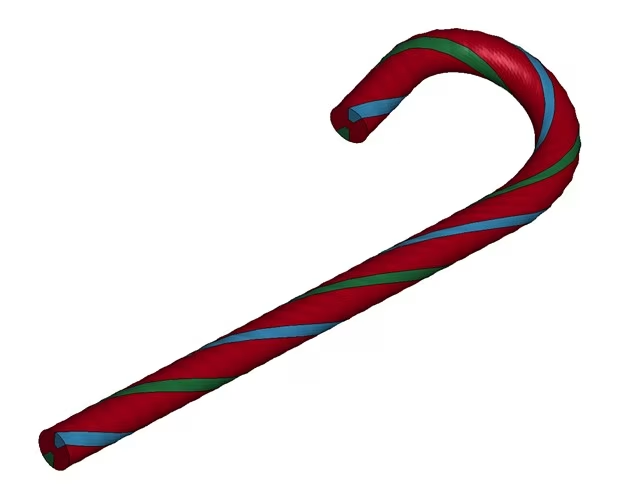
‘Tis the season for festive engineering. This year, I decided to put my finite element analysis skills to work on a seasonal icon: the candy cane. We all know the perils that follow once you see your beloved candy cane fall and shatter. With Ansys LS-Dyna, I set out to simulate what happens when a candy cane falls onto a rigid surface. Read on to see how I designed the experiment, developed a material model, and simulated the drop test—all while keeping things festive!
Building the Model
To capture the candy cane’s iconic stripes in the model, I utilized mesh morphing. Although the candy cane’s twisting introduced some skewing in the elements, we embraced the festive spirit and made the engineering assumption that this was acceptable. Hopefully, this keeps us off Santa’s naughty list!
I started this project with a candy cane plan, A sweet little profile to fit in my hand.
A cylinder came next, with a mesh oh so fine, to twist into something quite festive, divine.
Some profiles I made to help with the task, for morphing the mesh—it’s easy, just ask!
The stripes now appear in a classic design, they twist and they shimmer, a sight so fine.
With morphing complete, the mesh is just right; this candy cane’s ready—it’s quite the delight!
Material Definition
To understand the candy cane’s brittle behavior, I performed a simple 3-point bend test on a sample. The Sample broke around 50N of pressure. I did a quick bend test simulation in LS-Dyna to help determine Young’s modulus and fracture stress to use in the drop simulation.
There are many material models available in LS-Dyna, and a quick search of material databases yielded no results for candy canes. So, to keep things simple, I used *MAT_ELASTIC and *MAT_ADD_EROSION to add a sudden failure criterion since candy canes shouldn’t have much, if any, permanent deformation before failure. A more sophisticated material model could be built, but in the interest of having more time for family this holiday season, we will keep it simple.
Candy Cane Bend Test 1
Candy Cane Bend Test 2
After the simulation we can output a force vs displacement curve to help validate our material model. You can see below my generated graph. Our simulation showed the break around 47N of force, which closely matches physical testing.
Drop Test Simulation
With the material model defined, I simulated the candy cane falling from a height of approximately 6 inches onto a rigid surface. To speed up the simulation time, I set an initial velocity of the candy cane just before impact. Key highlights of the drop test include:
Fracture Animation: The simulation showed the candy cane shattering into pieces, mimicking real-world behavior.
Visualization of the stresses during the impact event.
Once the model is built and running, it’s easy to test additional load cases for different drop positions. For curiosity’s sake, I decided to see what would happen if it were dropped on the end instead of the side. The results are below.
Results and Insights
The drop test showed just how brittle candy canes are. While I’ve always known they were fragile, I was surprised to see it break into so many pieces from such a low height. It might be interesting to revisit this simulation with the plastic wrapping included to evaluate its effect on the results. Simulating the shipping packaging could also add an additional layer of complexity, but for now, let’s enjoy the festive chaos of our shattered candy cane this holiday season.
Would you fly in an airplane that AI created? As an engineer in awe of what fellow engineers have done to get an aircraft in the air and back down safely, my gut reaction is: definitely not. But after a momentary reflection of Boeing’s safety issues (Why Boeing’s Top Airplanes Keep Falling, New York Times, Feb 12,2024 and Downfall: The Case Against Boeing, Netflix, 2022, just two of many worrisome reports), I am willing to give AI a try.
Enter PhysicsX, a UK-based startup that promises a “quantum leap” with its software that blends AI with shape optimization.
PhysicsX showcases its technology in AI.airplane, a free online app that lets you design aircraft. You may not be able to design an aircraft down to its rivets nor create an aircraft of any commercial or military value, but you can have a lot of fun pretending to do real simulations on unreal aircraft.
AI.airplane will evaluate the overall shape for its lift, drag, stability and stresses, though that be the gross exterior shape only.
Granted the shapes are rudimentary, even playful – not the stuff of serious commercial or military aircraft. Nor is that PhysicsX’ intent. To use AI.airplane, you must sign off on the terms of service which state “Output may not always be accurate. Our Services are provided for technology demonstration and You should not rely on Output from our Services as a reliable source to create real outputs.“
In other words, don’t try this at work. It’s intended for hobbyists, for toys. Maybe you could use it for conceptual design. But it is not to be used for accurate, detail design of any type.
That being said, what a lot of fun AI.airplane can be.
Enter the weight of the aircraft and AI. airplane presents 20 possible shapes, each a deformable mesh that behaves like a sub-D model. You can deform it by pushing and pulling on deformable points. In a twinkling, you get what appear to be realistic pressure gradients (highest at nose and where wings meet the fuselage). Stresses are also highest where you would expect them to be.
How is PhysicsX’ so fast? AI.airplane’s speed and seeming accuracy are indeed remarkable. It is most certainly not painting colors for effect, a common marketing trick.
PhysicsX is, in effect, cheating. To put it more mildly, it is making an educated guess.
AI.airplane is a technology demonstrator, a publicly available app based on LGM-Aero. LGM stands for large geometry model, which is to shapes what large language models (LLMs, like ChatGPT) are for language.
LGM-Aero is trained on 25 million meshes and “tens of thousands” CFD and FEA simulations generously supplied by Siemens’ Simcenter, according to the company’s announcements. This is what is known in the AI world as unsupervised machine learning. In theory, if done well and if the shapes and conditions are similar from one to the next, the AI-based application can forego the millions of calculations FEA and CFD require and make an educated guess as to the result.
Having gone public with aircraft design has created tremendous buzz for PhysicsX. It may just be the shape of things to come. PhysicsX plan is to apply itself to more than just aerospace. It has already been used in automotive and has its sights on chip design, renewable energy and material research.
CFD can be about 100,000 times faster using a trained neural network, but there is a catch. Image: Neural Concept.
A analyst studying Formula 1 race cars may want to know how a racecar design would react in the turbulent wake of the car in front of it. But if each tweak of the shape or angles of the vents requires a CFD simulation, it could take forever. But what if you could learn from previous CFD simulation results and apply what you learned to the next simulation?
Providing the changes are gradual, not radical, Neural Concept, a small Swiss firm, can do just that: predict the solution without the time and resources required for CFD simulation.
I interviewed Pierre Baqué, CEO, for an article in engineering.com published April of 2023. I was glad to see they will be exhibiting at CES 2024. The technology looked quite promising then. Now, it seems compelling.
A simulation to calculate Cd (coefficient of drag) can take 4-8 hours. With a trained neural network, it can take a tenth of a second, according to Neural Concepts. That’s more than a 100 thousand times faster?
But as was explained to me in our previous conversation, there is a catch. You can’t throw any arbitrary shape Neural Concept and have it be solved immediately. The example above relies on Neural Concept being fed a steady diet of F1 car flow simulations. If we gave it an aircraft with radically different geometry, it would not work.
Neural Concept is ideal for repetitive simulation. Airbus is a user. I imagine them using it to study a thousand what-ifs, varying winglet angles, for example.
Neural Concept claims to make short work of sifting through your simulations, learning from them, and applying what was learned to suggest potentially thousands of optimized designs. But instead of a mind-boggling array of choices, the company uses proprietary algorithms to sort them.
Look for Neural Concept in the SWISSTECH pavilion at CES 2025 at the Venetian Expo (Eureka Park Booth #61033, Level 1, Hall G ).
There is no better argument for simulation than a virtual wind tunnel. Wind tunnels cost millions to make, thousands to rent, and unless you are near an automotive or aviation center, there’s no wind tunnel nearby. Their cost alone would steer you towards simulation. Siemens estimates the cost of one shift in their wind tunnel could easily exceed €20,000. You also have to factor in the cost of a full-scale prototype.
NVIDIA, Luminary Cloud, show virtual wind tunnel concept at SC24.
Product design cries out for a virtual wind tunnel. So many product shapes would benefit from streamlining. Think of boxy trucks, railroad cars with their miles of containers, and cargo and tanker ships, all of which use brute force to shove air and water out of their way. But the flow separation, the turbulent wakes, trailing vacuums and other phenomena that add up to enormous energy costs are all out of sight and out of mind.
Computational fluid dynamics, or CFD, means to make fluid flow visible. However, the computational power required to solve the millions of equations in even a simple CFD analysis is daunting. To simulate smoke trails for something the size of a car model in detail, in real-time, was impossible.
Until now.
Introducing OMNIVERSE Blueprint
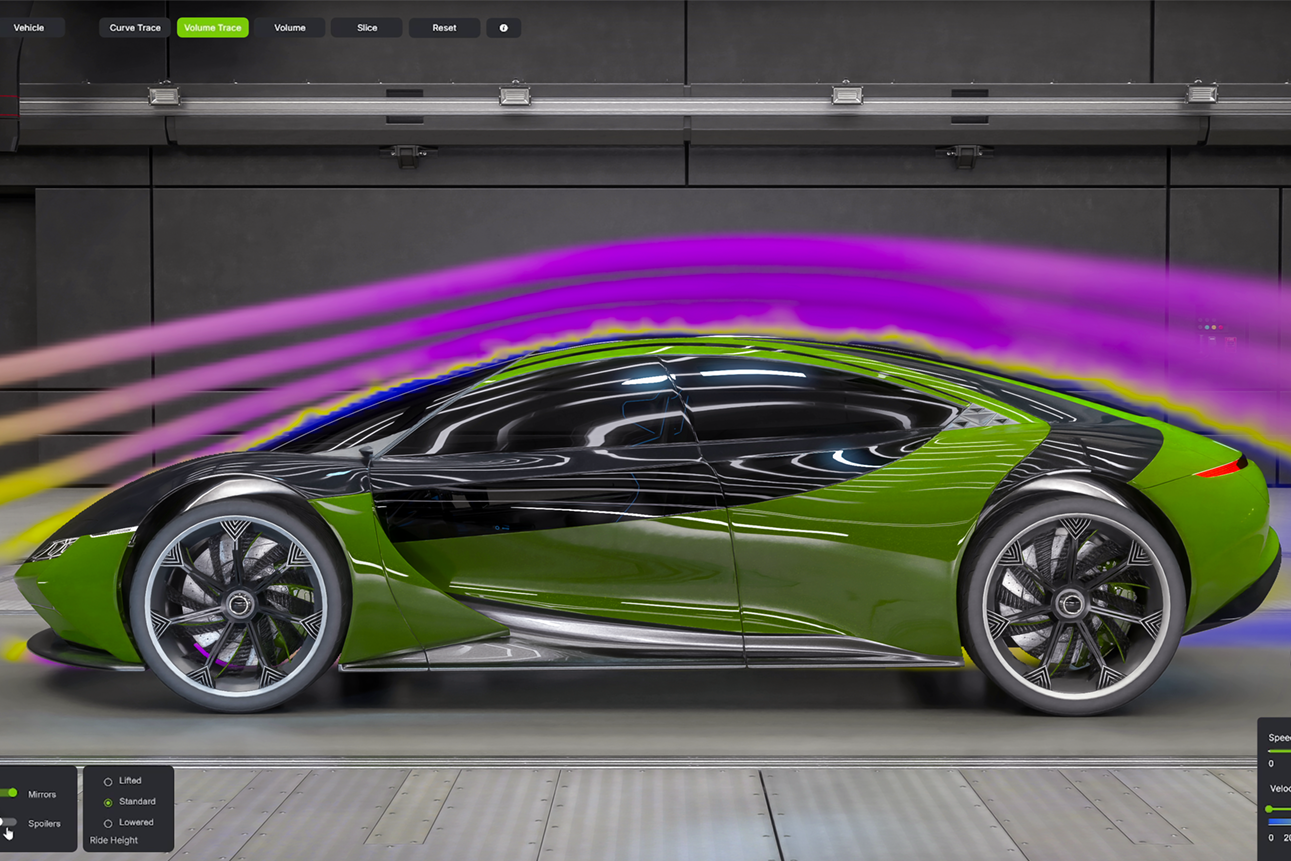
NVIDIA’s CEO and founder, Jensen Huang, in a special address at SC24, the Super Bowl of supercomputing recently concluded in Atlanta, Georgia, showed a fully operating virtual wind tunnel. It was a proof of concept, meant to show the potential of “infinite computing,” as racks of GPU servers are being sold, but nevertheless an eye-popping sight. We see a virtual tunnel that a frustrated engineer, denied an actual wind tunnel, could only dream of. We see the flow around a vehicle with smoke trails like in a wind tunnel. We see game-quality graphics, but we are assured the flow is real, i.e., based on CFD results. We see it in streamlines and pressure fields the way a CFD analyst would study it.
We see changes made at the push of a button. The car body swapped for another. At different heights above the ground, mirrors added and removed. We see the flow change immediately for every change.
What don’t we see? We don’t see the CFD mesh. We have to wonder how carefully the mesh was generated; knowing the mesh in the boundary layer is critical. We make a mental note to check before use. Only if the boundary layer mesh is adequate would we be able to enjoy freedom from meshing. We think of all the time that must be spent in getting a CAD model ready for simulation and meshing of the flow volume. A vehicle’s carefully detailed features, the wipers, trim, grill, and tire treads are removed in a process known as “defeaturing.” We do it so we don’t choke the computer, so we get results this week. NVIDIA has done away with that, as to say the size of the mesh, the number of equations to be solved, is of no concern. In other words, with the limitations of computing power eliminated, we may have entered the hallowed world of infinite computing.
In the video, we see the model geometry change and the flow immediately adapt.
Wait for It
Alas, the virtual wind tunnel is not yet a product you can buy or rent. It is a technology showcase named Omniverse Blueprint that is shown to various simulation vendors, such as Ansys, Altair, Siemens, and Luminary Cloud. These existing simulation vendors can plug their CFD into NVIDIA’s Omniverse to get a dynamic real-time simulation and, as an added bonus, also get gorgeous game-quality graphics.
NVIDIA has made a habit of supplying industry-specific software, such as for gaming and, more recently, AI, that makes use of their hardware, specifically GPUs. Omniverse Blueprint is that for simulation, with “powerful NVIDIA acceleration libraries, physics-AI frameworks, and advanced interactive rendering techniques, delivering simulation speeds up to 1,200 times faster and enabling real-time visualization.”
“Omniverse Blueprints are reference pipelines that integrate NVIDIA’s AI technologies, empowering leading CAE software developers to build next-generation digital twin workflows that will transform industries—from design and manufacturing to operations,” said Huang.
CFD is the first of the CAE applications shown. Presumably, FEA would follow. Next: design optimization?
We can only hope. NVIDIA can lead horses to water, but they can’t make them drink. Will simulation companies take advantage of the infinite computing being offered if it makes simulation invisible, like an engine under the hood, with only its results visible? Or will they want to keep showing off their finely crafted mesh, their cantankerous engines, their source of pride?